
One 4K PC to Six Projectors Over 120 m: Video Wall Controller and HDBaseT Solution
Deployment breakdown
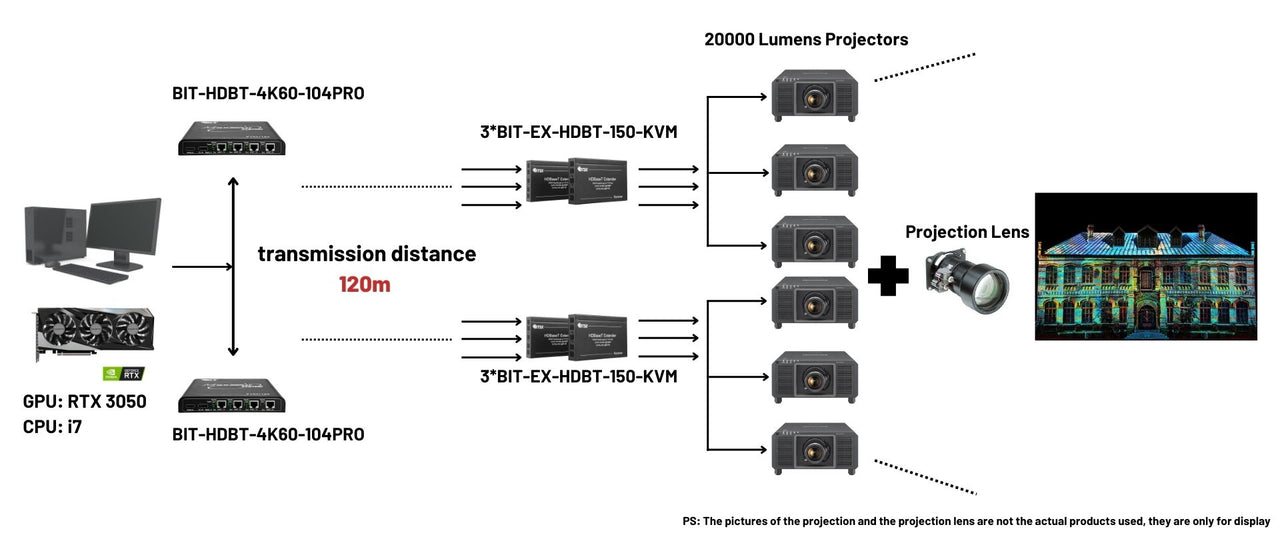
Romania building projection mapping deployment: one PC, two Bitvisus multi-screen expanders, six HDBaseT extenders and six projectors.
A single 4K workstation can drive six projectors across roughly 120 m of cable when the signal path is built around multi-screen processing and HDBaseT instead of one playback machine per projector. That is the architecture documented in a Romania building projection mapping deployment: one PC with an NVIDIA GTX 3050 GPU, two BIT-MSE-4K60-104Pro multi-screen expanders, and six BIT-Ex-HDBT-150-RX extenders feeding six projectors.
The deployment split the six projectors into two groups of three. Each group was edge-blended into a single image, and the documented combined canvas reached up to 11520 × 1200. The operator recorded one PC driving all six projectors, lower overall project cost and a reduced commissioning workload. The projection system has been in service at that site for five years.
For museum, light show and facade projection integrators, the interesting part is not a single specification. It is the planning logic: how a six-projector canvas is divided, where the processing sits, how 120 m of cable is organised, and which tasks move from the site into the configuration file.
Key takeaways
- One 4K PC source, two multi-screen expanders and six HDBaseT extenders replaced a multi-machine playback approach in a live building projection project.
- Two groups of three projectors produced a documented combined resolution of up to 11520 × 1200.
- HDBaseT carried the projector feeds over approximately 120 m, which is the distance the site required.
- The documented results were lower overall project cost, reduced commissioning workload, and five years of service at the site.
Problem Definition: Six Projectors, One Source, 120 Metres of Cable
The design constraint is easy to state and awkward to solve. The 4K source sits in a control position or a temporary show booth, while six projectors are mounted on a building facade or a long museum wall roughly 120 m away. The audience sees one continuous image, not six rectangles.
Three problems appear at the same time.
- Canvas continuity. Six independent projector feeds look like six independent projector feeds. The content must be mapped across the whole surface, with overlap handled inside each group of projectors.
- Distance. At roughly 120 m, a direct copper HDMI connection from the source position to the projector positions is not a practical signal path. The installation needs an extension layer designed for that run.
- Source count. Every additional PC, media server or playback machine adds another timecode, another colour reference and another geometry set that must be aligned with the others before opening night.
The Romania project resolved all three with one processing layer. The PC stayed a PC, the processing layer created the projector feeds, and the extension layer handled the distance. The result was a six-projector canvas driven by one machine, with the commissioning effort concentrated in two expanders rather than spread across six playback systems.
This is also where the choice between a full video wall controller and a multi-screen expander becomes practical rather than theoretical. A modular video wall controller earns its place when many inputs must be switched across a matrix, when KVM or monitoring workflows are involved, or when the wall must be reconfigured between sources. When the requirement is to take one high-resolution source, cut it into fixed projector groups and carry those groups over long cable runs, an expander-based signal path is the leaner design.
Industry Background: Why Single-Source Projection Keeps Winning
Projection mapping and immersive exhibition work has moved steadily toward fewer, more powerful sources. The commercial context supports that direction. Dataintelo estimates the global video wall controllers market at approximately USD 2.25 billion in 2025, projected to reach USD 4.4 billion by 2034, with a reported CAGR of 7.8% from 2025 to 2034.
Transport is shifting as well. GCG Enterprise Solution, citing AVIXA, reports that AV-over-IP reached 73% of new video wall controller installations in early 2026, while legacy 4U hardware processors lost 18% market share in 2025. Those figures describe a market moving toward networked orchestration and away from large fixed chassis.
Point-to-point HDBaseT has not disappeared from that picture, and it is not supposed to. A building projection show with a fixed projector layout, a known show network and a deterministic playback requirement often benefits from a signal path that behaves the same way every evening. HDBaseT carries the projector feed over the installed cable, keeps the processing deterministic, and avoids introducing a network configuration layer into a temporary or heritage building where the conduit already exists.
The same controller category also serves control rooms, security monitoring walls and conference rooms, where low-latency video wall controllers, rack-mount chassis and remote management over a web interface matter more than edge blending. The processing principles are shared; the configuration priorities are not. For a museum or light show integrator, the deciding factors are canvas size, cable route, group structure and commissioning time.
Detailed Solution: Two Expanders, Six HDBaseT Extenders, One PC
Shenzhen Bitvisus Technology Ltd. is a Shenzhen-based manufacturer of 4K and 8K image and video processing hardware, including video wall controllers, multi-screen expanders, projector fusion processors, matrices and extenders. In the Romania deployment, the Bitvisus video wall controller portfolio was represented by two multi-screen expanders and six HDBaseT extenders, not by a modular matrix chassis.
The signal path was straightforward. One PC with an NVIDIA GTX 3050 GPU acted as the single source. Two BIT-MSE-4K60-104Pro multi-screen expanders divided and processed the source into two projector groups. Six BIT-Ex-HDBT-150-RX extenders carried those feeds to the six projectors over approximately 120 m of cabling.
| Equipment | Quantity | Role in the deployment |
|---|---|---|
| PC with NVIDIA GTX 3050 GPU | 1 | Single 4K source for the full six-projector show |
| BIT-MSE-4K60-104Pro multi-screen expander | 2 | Splits and processes the source into two projector groups of three |
| BIT-Ex-HDBT-150-RX extender | 6 | Carries each projector feed over approximately 120 m |
| Projectors | 6 | Three per group, edge-blended into one image per group |
| Documented combined canvas | Up to 11520 × 1200 | Result recorded for the two blended projector groups |
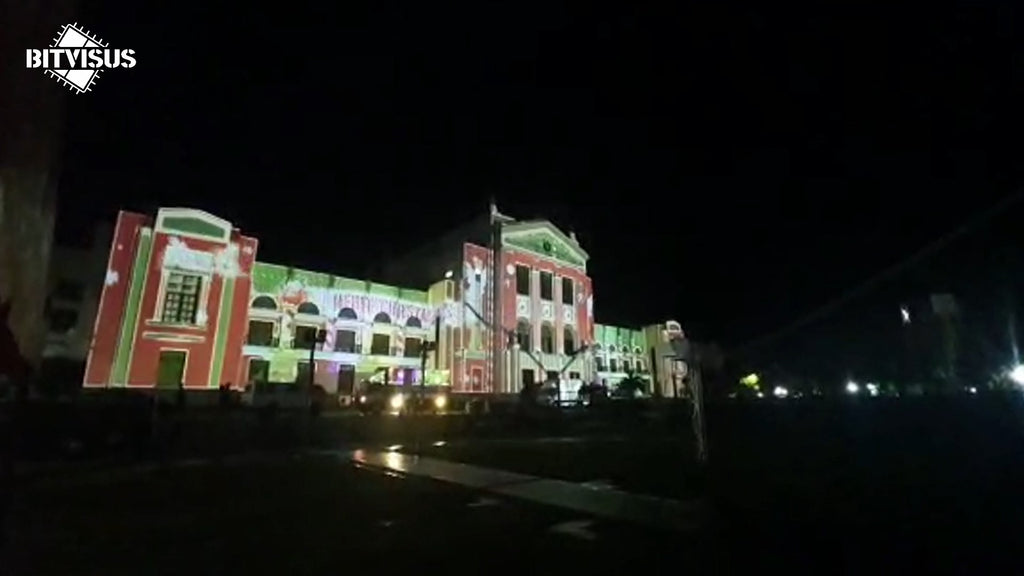
The Romania deployment used two expanders and six HDBaseT extenders to keep one source in charge of the whole canvas.
The expander is the part that changes the commissioning workload. A multi-screen expander takes one high-resolution source and maps it across a group of outputs, so three projectors behave as one canvas instead of three independent displays. In this project each expander served one group of three projectors, and the blending was resolved inside the group.
The extender is the part that changes the cable schedule. Six HDBaseT extenders meant six projector feeds could travel the site distance without a playback machine at the far end. The PC, the processing and the show control stayed together in one location.
Bitvisus describes its processing as pure hardware parallel processing built on self-developed FPGA image processing, with a zero-latency design intent. For a scheduled show this matters less as a headline number and more as predictability: the signal path does not depend on a general-purpose operating system at each projector position.
Step-by-Step Breakdown: From Canvas Maths to Final Blend
The sequence below follows the logic of the Romania deployment and is written for integrators planning a comparable six-projector installation.
- Fix the canvas before choosing hardware. Start with the image the audience will see. In the Romania case the target was two blended groups producing a combined canvas of up to 11520 × 1200. Write down the group count, the overlap allowance and the total pixel budget before any purchase order is raised. Canvas maths drives every later decision.
- Divide the canvas into equal output groups. Six projectors were split into two groups of three rather than treated as one flat array. Equal groups simplify blending, keep each expander inside a comfortable output count, and make fault-finding faster during commissioning.
- Decide where the processing lives. Keeping the PC and both expanders at the source position concentrates heat, power and service access in one rack or booth. The projectors then receive only what the extension layer delivers. This is the layout that made a single-PC workflow practical on a building facade.
- Design the 120 m cable route. Survey the path before specifying cable. Facade shows often route through service shafts, roof voids or temporary trunking, and the cable schedule must reflect the real route rather than a straight line on a plan. Each projector position needs its own feed and its own labelled endpoint.
- Pair each projector with an extender. Six projectors, six BIT-Ex-HDBT-150-RX extenders. One-to-one pairing keeps the mapping between processing output, cable label and projector input unambiguous, which is exactly what reduces commissioning time on site.
- Blend inside each group, not across the entire wall. Treat each group of three as its own blending problem. Overlap, geometry and colour are aligned within the group first; the two finished group images are then aligned to each other. This staged approach is easier to debug than a single six-projector blend.
- Commission group by group, then the full canvas. Verify group one, verify group two, then verify the seam between them. Keep the configuration file under version control. For remote sites, free remote debugging and 7×24 technical support allow the integrator to resolve configuration questions without a second site visit.
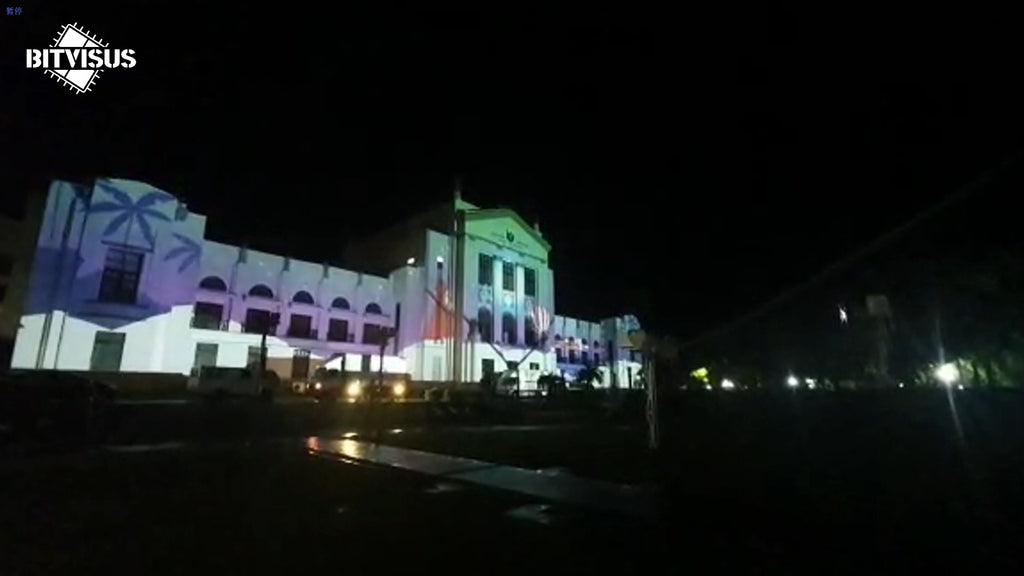
Blending each group of three projectors separately shortens the commissioning path.
Layout Planning Notes for Museum and Light Show Integrators
Most of the savings in a deployment like this are designed in before the equipment arrives. The following planning notes reflect the constraints that shaped the Romania installation.
- Plan overlap zones on the drawing, not on the wall. Decide which projector edges overlap and how much of the canvas each overlap consumes. The blend then follows the drawing.
- Keep the source and processing in one serviceable location. A single PC plus two expanders is a compact technical position that can be locked, powered and cooled as one point of responsibility.
- Label every cable at both ends. With six long projector feeds, a clear naming convention from expander output to projector input saves hours during fault-finding.
- Test with the final media. Building projection content often includes large image files and long playback timelines. Validate the full canvas with the actual show content rather than a test pattern alone.
- Keep a cold spare for the critical path. A spare expander or extender shortens the recovery time if a unit is damaged during a seasonal installation.
- Choose the control method early. Bitvisus equipment supports remote Web-LAN control, RS232 serial control and IR remote control, so the show control strategy can be decided before commissioning rather than during it.
Use Cases: Where This Topology Fits
Museum building projection mapping. The Romania case is a museum building projection mapping application. The projectors sit outside the building envelope and the source sits inside a protected position, which makes the HDBaseT run the natural backbone.
Seasonal light shows and Christmas 3D shows. The same deployment was used for a Christmas building 3D projection mapping light show. Seasonal shows benefit from a compact technical footprint because the equipment is installed and removed on a schedule.
Immersive art exhibitions at larger scale. When the wall grows, the processing model scales into controller territory. A documented Shenzhen immersive exhibition deployed more than 100 industrial 1080p projectors with 12 Bitvisus video wall controllers, each BIT-VWC-409R driving nine projectors in a 3×3 configuration. Each 3×3 wall produced 5K 5760 × 3240, and multiple walls were recombined to exceed 16K. That project has also been in service for five years.
Visitor centres, brand pavilions and cultural venues. Any venue with a long distance between the technical room and the projection surface faces the same three constraints: canvas continuity, distance and source count. The expander-plus-HDBaseT pattern answers all three without placing a PC at every projector.
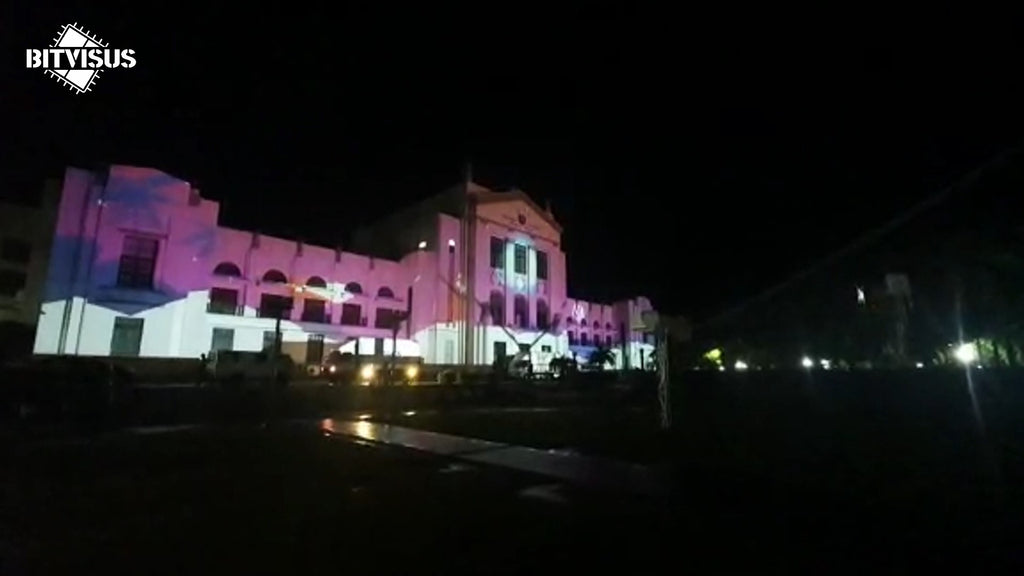
Facade and museum shows reuse the same signal logic: one source, grouped processing, long-distance transport.
Comparison: Two Documented Bitvisus Configurations
The table compares two documented deployments rather than two hypothetical product categories. Both are real sites, and both have recorded five years of service.
| Parameter | Romania building projection | Shenzhen Cézanne exhibition |
|---|---|---|
| Project type | Christmas building 3D projection mapping light show | Immersive painting art exhibition |
| Source | 1 PC with GTX 3050 GPU | PC-based playback |
| Processing | 2 × BIT-MSE-4K60-104Pro multi-screen expander | 12 × BIT-VWC-409R video wall controller |
| Long-distance transport | 6 × BIT-Ex-HDBT-150-RX, approx. 120 m | Not specified in the case record |
| Projector count | 6 | More than 100 industrial 1080p projectors |
| Group layout | 2 groups of 3, each fused into one image | 3×3 per controller, 9 projectors per wall |
| Documented canvas | Up to 11520 × 1200 | 5K 5760 × 3240 per wall, combined above 16K |
| Documented outcome | One PC driving all six projectors, lower overall project cost, reduced commissioning workload | Large-scale fusion with edge blending and warping, scalable operation |
| Service period | 5 years | 5 years |
The comparison shows where each architecture belongs. Six projectors and one fixed layout sit comfortably on two expanders. A hundred projectors, multiple walls and a recombined image above 16K belong on a controller-based design with more processing nodes. Choosing the larger architecture for a six-projector show adds cost and commissioning steps without adding capability the show can use.
FAQ
Are the multi-screen expanders and HDBaseT extenders certified for EU installation?
Bitvisus holds CE-EMC, FCC SDoC and RoHS declarations for the 12V-input multi-screen splicing processor family covering the MSE, VWC and MV series, with BIT-MSE-8K60D-104Pro as the lead model. The certificate numbers are CTC118K0401301EC for CE-EMC, CTC118K0401301FC for FCC SDoC and CTC118K0401301RC for RoHS, all issued on 2026-05-11 by Shenzhen Circle Testing Certification Co., Ltd. The CE declaration references EN 55032:2015/A11:2020, EN 55035:2017/A11:2020 and EMC Directive 2014/30/EU. A separate set of declarations covers the 220V-input modular multi-screen splicing matrix processor series with BIT-VWC-MD1212Ma as the lead model. Integrators should request the declaration that matches the exact model and input voltage in the bill of materials before submitting a tender package.
Can one PC really drive six projectors at 4K with edge blending?
Yes, and the Romania deployment is the documented example. One PC with an NVIDIA GTX 3050 GPU fed two BIT-MSE-4K60-104Pro multi-screen expanders, and six BIT-Ex-HDBT-150-RX extenders carried the outputs to six projectors over approximately 120 m. The projectors were organised into two groups of three, each group was edge-blended into one image, and the recorded combined resolution reached up to 11520 × 1200. The operator reported one PC driving all six projectors as an achieved benefit.
How does this configuration reduce overall project cost?
The cost reduction comes from the architecture rather than from a discounted component. The documented Romania case records lower overall project cost for the light show operator together with a reduced commissioning workload and lower project costs. One PC replaced the need for separate playback machines at each projector group, and two expanders concentrated the canvas configuration in a single processing layer. Fewer source machines mean fewer operating systems to maintain, fewer timecode references to align and fewer devices requiring service access on a building facade.
Can an integrator test a sample before committing to a full show build?
Standard models are available from one unit as the minimum order quantity, which allows a bench test of two expanders and six extenders before site work begins. Standard stock lead time is 3 to 7 days. Bitvisus also provides free solution design and free technical drawings, which helps an integrator validate the canvas and cable schedule before installation. A one-year warranty applies to video wall controllers, and multilingual technical documentation is available in Chinese and English.
What is the lead time for a six-projector system, and how do I request a quote?
Standard stock models ship in 3 to 7 days, custom orders typically take 2 to 3 months, and export orders are cleared through customs and shipped within 10 days. Monthly production capacity is 8,000 units, and products are exported to Europe, North America, the Middle East, Southeast Asia and more than 20 countries and regions. To request a sample or a project quote for a six-projector HDBaseT layout, contact Eddie at eddie.jia@bitvisus.com or +86 186-8150-9089 on WhatsApp, and include the projector count, group structure, cable distance and canvas resolution. The full product catalogue is available for download as the 2026 Bitvisus Product Brochure.
Conclusion
Six projectors over roughly 120 m is not a distance problem that a longer cable solves. It is a system design problem. The Romania deployment answered it with two BIT-MSE-4K60-104Pro multi-screen expanders, six BIT-Ex-HDBT-150-RX extenders and one PC with a GTX 3050 GPU, producing two edge-blended groups and a documented canvas of up to 11520 × 1200.
The recorded outcomes are the ones integrators actually bid on: one PC driving all six projectors, lower overall project cost, reduced commissioning workload, and five years of service at the site. For museum and light show teams planning a comparable installation, the practical starting point is the canvas, then the group structure, then the cable route, and only then the equipment list.
Bitvisus designs and manufactures video wall controllers, multi-screen expanders, projector fusion processors and extenders for projection mapping, immersive exhibitions and professional display projects. To discuss a six-projector layout or request a sample configuration, contact the team at bitvisus.com or email eddie.jia@bitvisus.com.
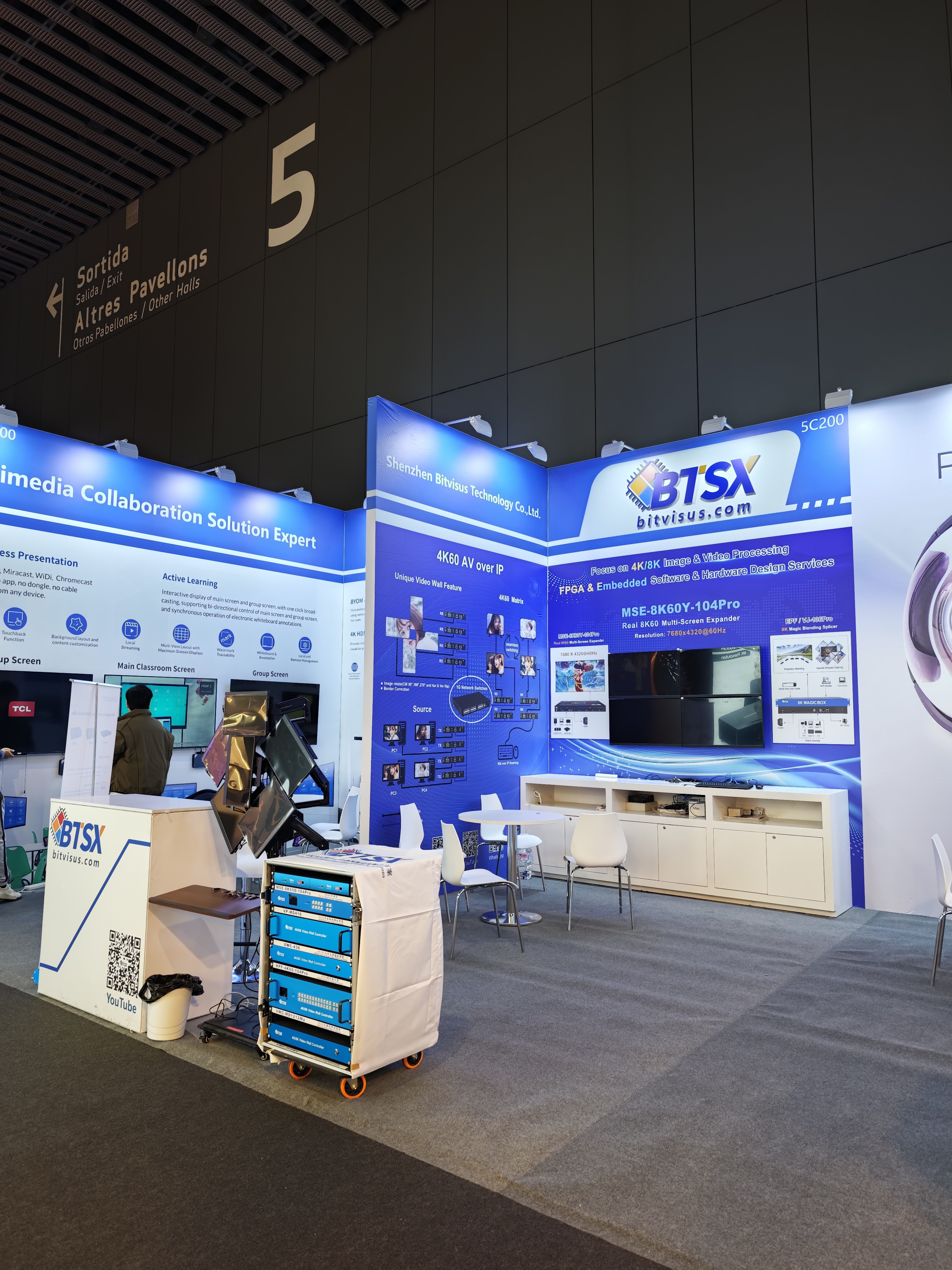
Sample requests, layout drawings and project quotes are handled directly by the Bitvisus technical team.
Next step: send your projector count, group structure, cable distance and target canvas resolution to eddie.jia@bitvisus.com or +86 186-8150-9089, and request the Bitvisus product brochure for the full model list.
Have Questions or Need More Details?
Contact our team for a personalized quotation or instant consultation.
Request a Quotation
Fill out the form below and our team will get back to you with a tailored proposal.
WhatsApp Direct Chat
Prefer to chat in real-time? Message us on WhatsApp for instant assistance & quick answers.
- Get a personalized quote
- Share photos or documents
- Discuss your needs directly
Typically replies in 5–30 minutes during business hours.