
Recommended Video Wall Controller Configurations for Large Projection: A Deployment Ranking
Recommended Video Wall Controller Configurations for Large Projection: A Deployment Ranking
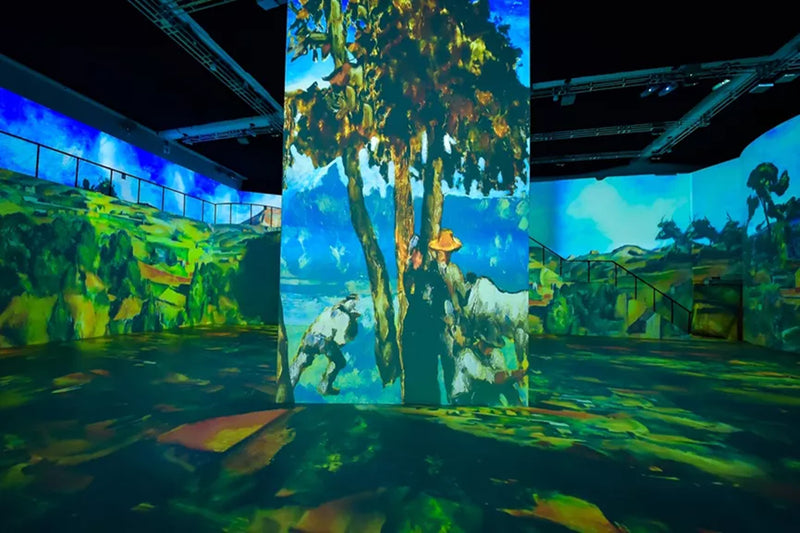
Large projection projects are seldom lost because of the projectors. They are lost because of how projectors are grouped, how the image is split across outputs, how far the signal has to travel, and how much commissioning time the integrator has to absorb. This article ranks three video wall controller configurations that are documented on delivered large-projection projects. All three have been in service for five years.
The ranking at a glance — ordered by the documented scale of the problem each configuration solved:
- Rank 1 — Twelve BIT-VWC-409R controllers, one per 3x3 projector group, 5K 5760x3240 output per wall, more than 100 industrial 1080p projectors, and a recombined image resolution exceeding 16K.
- Rank 2 — Two BIT-MSE-4K60-104Pro multi-screen expanders with six BIT-Ex-HDBT-150-RX receivers, one PC driving six projectors over approximately 120 m of HDBaseT distribution, combined output 11520x1200.
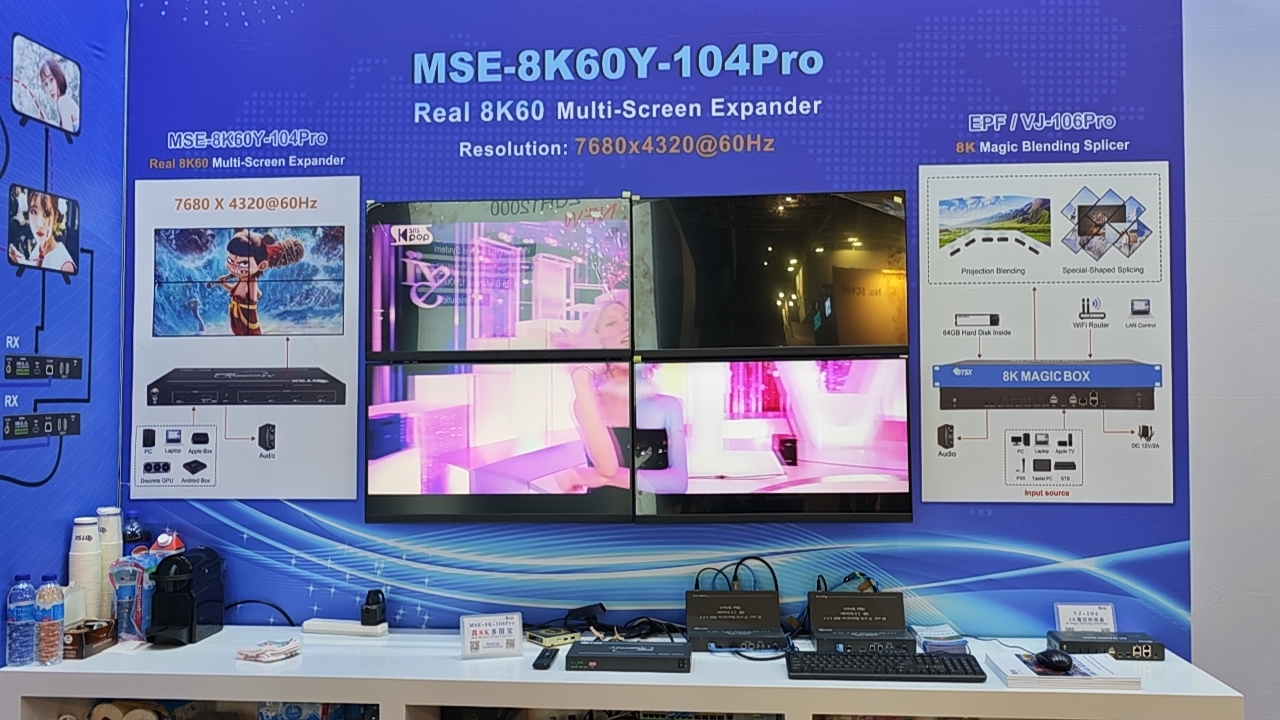
- Rank 3 — One BIT-MSE-8K60D-104Pro driving four projectors in a single 1x4 hardware tiling group.
This ranking compares deployment architectures, not brands. Every figure below comes from documented project records or published product specifications.
The Real Problem: Large Projection Is a Grouping Problem, Not a Projector Problem
Four constraints decide whether a multi-projector system can be commissioned on schedule, and each one is a direct consequence of the video wall controller chosen.
- Geometry. Blended edges and warped surfaces have to be corrected somewhere. Where the processing node handles the split natively, the integrator spends less time in software alignment.
- Output channel count. A single chassis has a fixed output ceiling. In the Bitvisus range this runs from four HDMI outputs on the compact expanders to nine outputs on the BIT-VWC-409R and eighteen outputs on larger controllers. Scale therefore comes from grouping projectors into fixed-size blocks and adding nodes.
- Transport distance. Copper HDMI output ceilings of about 15 m are normal on these processing nodes. Facade and museum installations routinely need five to ten times that distance.
- Commissioning and cost. Every extra source device, extra splitter and extra alignment pass adds hours on site. The configurations ranked below were selected partly because the site reports specifically describe reduced commissioning workload.
In other words, the design decision that matters most is not which controller is fastest, but how many projectors you place under each processing node, what resolution that produces, and what carries the signal from the source rack to the last projector in the run.
Industry Background: Where Large Projection Demand Is Heading
Third-party research places the global video wall controllers market at approximately USD 2.25 billion in 2025, projected to reach USD 4.4 billion by 2034, a CAGR of 7.8% across 2025–2034 (Dataintelo, 2026). Market-size estimates differ by definition: published figures range from roughly USD 0.55 billion to USD 2.25 billion depending on whether a controller is counted as processor hardware or as a complete display-management solution.
Two application signals matter for projection buyers. Control Room applications account for 50% of video wall processor market contribution (Statifacts), while AV-over-IP reached 73% of new video wall controller installations in early 2026 (GCG Enterprise Solution / AVIXA). At the same time, legacy hardware processors in 4U chassis lost 18% market share in 2025 as users shifted toward AV-over-IP and software orchestration (GCG Enterprise Solution).
The practical read is that network-first signal transport is now the default for new installations, while deterministic hardware processing remains the backbone of large projection canvases where per-output geometry and stable, low-latency behaviour matter more than routing flexibility. Control-room layouts are additionally subject to ISO 11064, the international standard for control-room ergonomics, which constrains how a wall is organised and managed. For import and customs teams, video wall controllers are commonly classified under HS code 85437099 or 85437042.
The Deployment Ranking: Three Field-Proven Configurations
Rank 1 — Twelve BIT-VWC-409R Controllers Behind a 3x3-Per-Controller Immersive Wall
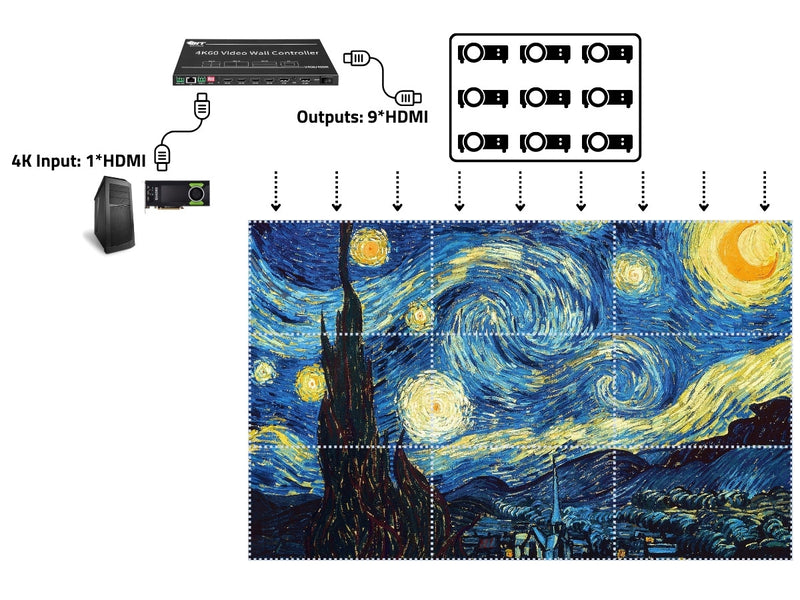
The largest documented configuration in this ranking uses twelve Bitvisus video wall controllers, each driving nine projectors in a 3x3 video wall. Each 3x3 wall delivers 5K 5760x3240 output, multiple 3x3 walls are recombined into a final image resolution exceeding 16K, and the total fleet covers more than 100 industrial 1080p projectors. The deployment is the Cezanne immersive painting art exhibition in Shenzhen, China, operated by an exhibition hall and immersive art exhibition organiser, and it has been in service for five years.
The reason it ranks first is the scale one product family absorbed. A single BIT-VWC-409R rotating splicing processor accepts 3x HDMI 1.4, 1x HDMI 2.0 and 1x DP 1.2 inputs with HDCP 2.2 support, and outputs 9x HDMI 1.3 at 1920x1080 at 60 Hz over cable runs up to 15 m, plus a DP 1.2 loop-out. Splicing is limited to nine screens inside one device, so anything larger depends on multi-device cascading and parallel use of multiple devices — which is precisely how twelve units and more than 100 projectors were combined into one canvas.
Processing runs on a 40 nm chip using a full hardware real-time architecture, so the split is executed in hardware rather than rendered in software. Edge blending and warping software complete the picture, power-down memory restores the wall layout after a power event, and control is available through infrared remote, RS232 serial port and PC upper computer software, with DHCP support on the network side. The documented result is a wall that scales in blocks, holds a stable image, and adapts to multiple resolutions and layouts.
Where this configuration fits: immersive exhibitions, art and museum walls, and command or dispatch walls where the output count per group is fixed at nine and image continuity across a large canvas outranks per-seat flexibility.
Rank 2 — Two BIT-MSE-4K60-104Pro Expanders with Six HDBaseT Receivers over 120 m
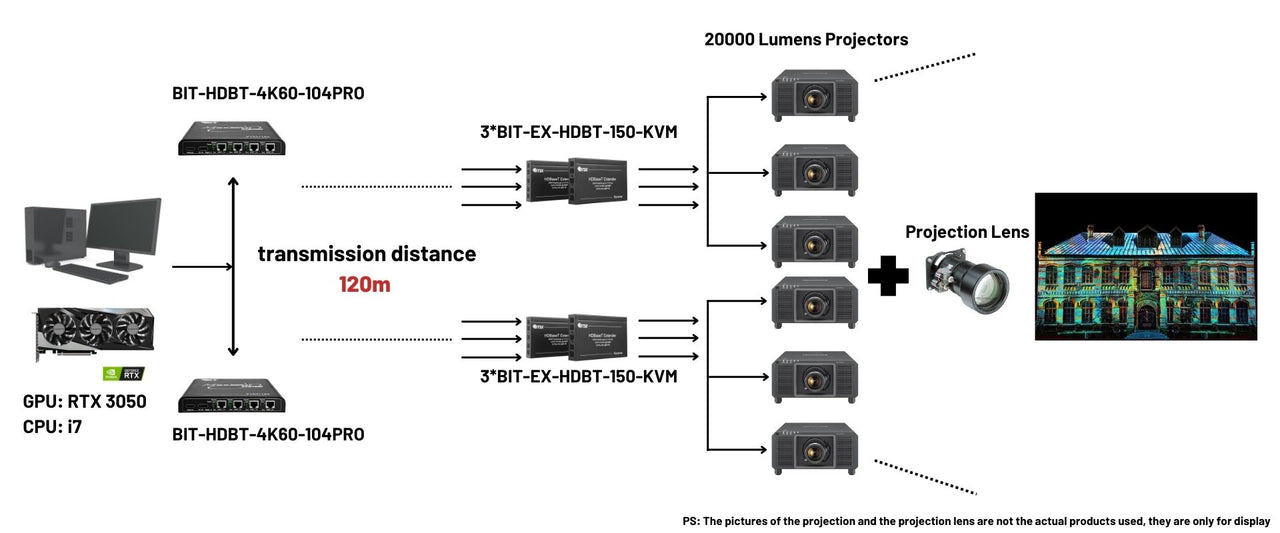
The second configuration solves distance rather than channel count. A 3D projection mapping competition and building light show deployment in Romania used one PC with a GTX 3050 GPU, two BIT-MSE-4K60-104Pro multi-screen expanders and six BIT-Ex-HDBT-150-RX extenders, with the longest signal run at approximately 120 m. Six projectors were driven by that single PC in two groups of three, each group fused into one image, for a combined resolution of 11520x1200. The application is a Christmas building 3D projection mapping light show and museum building projection, and the system has been in service for five years.
The engineering logic is that the expander's 3x1 tiling mode supports up to 1920x3600 or 5760x1200 at 60 Hz, and its 4x1 mode up to 1920x4800 or 7680x1200 at 60 Hz, so the split matches the projection geometry without an extra rack of hardware. Input is HDMI or DP with HDMI priority and HDCP 2.2; output is 4x HDMI with a 15 m output distance, and factory default output is 3840x2160 at 60 Hz in 2x2.
Beyond that 15 m ceiling, the BIT-Ex-HDBT-150-RX carries 1200P at 60 Hz over CAT6E up to 150 m, with 6 Gbps transmission bandwidth, two-way RS232 and two-way IR transparent transmission, HDMI 1.4 and HDCP 2.2 with DVI 1.0 and VGA compatibility, and unidirectional PoE supply. The outcomes recorded for the light show operator were one PC driving all six projectors, a reduced commissioning workload, and lower project cost.
Where this configuration fits: building facades, seasonal light shows, museum projections and heritage installations where the binding constraint is source-to-projector distance rather than the number of outputs.
Rank 3 — One BIT-MSE-8K60D-104Pro for Four Projectors in 1x4 Tiling
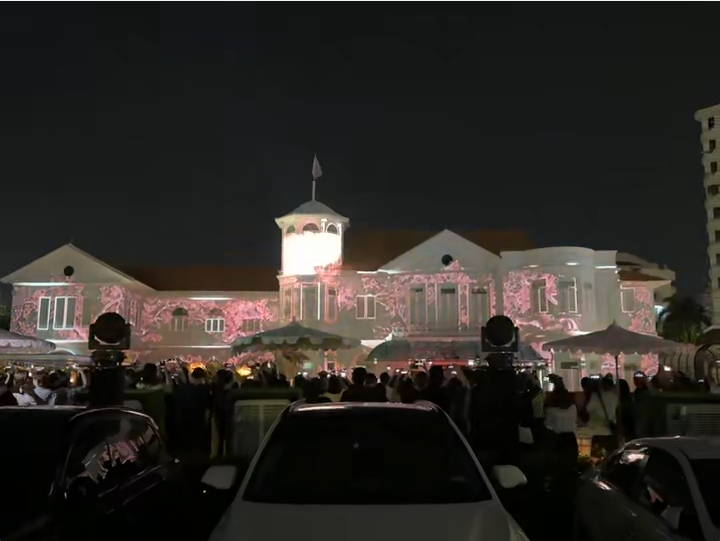
The most compact configuration in this ranking uses one BIT-MSE-8K60D-104Pro 8K60 multi-screen expander to drive four projectors with hardware 1x4 tiling, supporting 1x1, 1x2, 1x3, 1x4 and 2x2 tiling modes. The documented deployment is a large-scale building facade projection mapping project in Kuala Lumpur, Malaysia, used for national day celebrations and commercial plaza multimedia light shows, and it has been in service for five years. The case record notes 1x4 hardware tiling with phase-locked, colour-unified outputs and uncompressed 8K60 processing.
Behind that sits a single DP 2.1 input on copper up to 3 m, a maximum input pixel clock of 2400 MHz and HDCP 1.4/HDCP 2.3 support. Input resolution reaches 7680x4800 at 60 Hz and 7680x4320 at 60 Hz in 2x2, and 15360x2160 at 30 Hz in 1x4. On the output side, 4x HDMI 2.0 ports run at a maximum 600 MHz pixel clock and deliver up to 3840x2400 at 60 Hz per output, with custom resolutions supported. Power draw is 28 W from a 12V5A supply, and the unit can be racked with an optional 1U tray.
Where this configuration fits: facade mapping, landmark shows and commercial plazas where a single chassis, four projectors and a small control footprint are preferred. Note the framing: the 1x4 input ceiling of 15360x2160 is a 30 Hz mode, so a 60 Hz show should stay inside the 2x2 8K60 envelope or add a second expander.
Step-by-Step: How to Specify a Configuration Like These
- Count projectors and fix the group size. Three by three per group points to the BIT-VWC-409R with its nine outputs. Two groups of three points to two BIT-MSE-4K60-104Pro units, each offering four outputs with three in use per group. A single row of four points to the BIT-MSE-8K60D-104Pro in 1x4.
- Calculate the per-group resolution from panel resolution multiplied by layout. A 3x3 array of 1920x1080 outputs produces 5760x3240, which is the 5K figure recorded in the Cezanne wall. A 3x1 row of 1920x1200 outputs produces 5760x1200, matching the Romania groups.
- Match the processing node to the source signal. For 4K60 sources, the BIT-MSE-4K60-104Pro accepts HDMI or DP with a 600 MHz input pixel clock, while the BIT-VWC-409R accepts HDMI 2.0 and DP 1.2 alongside legacy HDMI 1.4 inputs. For an 8K60 source, the BIT-MSE-8K60D-104Pro takes DP 2.1 at 2400 MHz.
- Solve transport distance before you choose nodes. Output ceilings are 15 m on the BIT-VWC-409R and on the BIT-MSE-4K60-104Pro. Beyond that, insert HDBaseT receivers such as the BIT-Ex-HDBT-150-RX, which carry 1200P at 60 Hz up to 150 m over CAT6E.
- Decide how many source PCs are genuinely required. The Romania configuration deliberately used one PC for six projectors. On the larger wall, parallel use and multi-device cascading are what let twelve separate controllers behave as one canvas.
- Plan geometry and control paths. Edge blending and warping software run alongside the hardware. Control routes include infrared remote, RS232 serial and PC upper computer software on the BIT-VWC-409R with DHCP support, and RS232, WEB, button board, remote control and WEB API on larger modular chassis such as the BIT-VWC-MD3636Ma 4K60 seamless matrix splicer.
- Lock power, mounting and environment, then confirm compliance and schedule. Typical figures are 12V 2A and 12 W for the BIT-VWC-409R, 12V at 2A for the BIT-MSE-4K60-104Pro and 12V5A at 28 W for the BIT-MSE-8K60D-104Pro, with storage and working temperatures of -10 to 50 degrees Celsius.
Use Cases: Where Each Configuration Earns Its Place
Immersive exhibitions and art venues
Rank 1 exists because of a cultural venue. More than 100 industrial 1080p projectors, twelve controllers and a five-year operating life describe a wall that is switched on daily, not a temporary show. Where a venue needs multiple 3x3 blocks recombined into a single canvas, the nine-output-per-chassis design keeps the architecture regular and repeatable.
Building facades and seasonal light shows
Ranks 2 and 3 are facade configurations. The Romania system distributes one PC signal to six projectors across roughly 120 m, and the Malaysia system keeps a four-projector 1x4 tiling group inside a single expander. Both patterns suit sites where projectors sit far from the control position and shows are scheduled, event-driven or seasonal.
Control rooms and monitoring walls
Control-room applications account for 50% of video wall processor market contribution, and the same 4-in/9-out splicing architecture used in Rank 1 is documented as an applicable product for command and dispatch centres and security monitoring walls, typically in 3x3 or 2x4 configurations. These installations are also the ones most likely to be reviewed against ISO 11064 for layout and operator ergonomics.
Side-by-Side Comparison of the Three Configurations
| Comparison item | Rank 1: 12x BIT-VWC-409R | Rank 2: 2x BIT-MSE-4K60-104Pro plus 6x BIT-Ex-HDBT-150-RX | Rank 3: 1x BIT-MSE-8K60D-104Pro |
|---|---|---|---|
| Processing node type | Rotating splicing processor | 4K multi-screen expander with HDBaseT receivers | 8K60 multi-screen expander |
| Projectors in documented deployment | More than 100 industrial 1080p projectors | 6 projectors, in two groups of three | 4 projectors |
| Layout per node or group | 3x3, nine outputs per device | 3x1 per expander group | 1x4 hardware tiling (1x1, 1x2, 1x3, 2x2 also supported) |
| Output resolution | 1920x1080 at 60 Hz per output; 5760x3240 per 3x3 wall | Up to 5760x1200 at 60 Hz in 3x1 mode | Up to 3840x2400 at 60 Hz per output |
| Combined documented resolution | Exceeding 16K after recombining walls | 11520x1200 | Not stated in the case record |
| Input capability | 3x HDMI 1.4, 1x HDMI 2.0, 1x DP 1.2, HDCP 2.2 | HDMI or DP with HDMI priority, HDCP 2.2, 600 MHz input | 1x DP 2.1, 2400 MHz input, HDCP 1.4/HDCP 2.3 |
| Signal transport | HDMI output up to 15 m | HDBaseT up to 150 m over CAT6E; about 120 m used | HDMI 2.0 output on copper up to 5 m |
| Control | Infrared remote, RS232, PC upper computer, DHCP | Not stated for the expander; receivers add two-way RS232 and IR | Not stated in the case record |
| Documented site | Shenzhen, China — Cezanne immersive painting art exhibition | Romania — building 3D projection mapping light show | Kuala Lumpur, Malaysia — building facade projection mapping |
| Time in service | 5 years | 5 years | 5 years |

Frequently Asked Questions
Which compliance documents support these video wall controllers for EU and US projects?
Shenzhen Bitvisus Technology Ltd. holds CE-EMC declarations of conformity CTC118K0401302EC (220V input) and CTC118K0401301EC (12V input), RoHS declarations CTC118K0401302RC and CTC118K0401301RC, and FCC Supplier's Declarations of Conformity CTC118K0401302FC and CTC118K0401301FC. All six were issued on 2026-05-11 by Shenzhen Circle Testing Certification Co., Ltd. The FCC declarations name OMA Electronic Technology Inc as the US responsible party. The declared scope covers the MSE, VWC and MV series, with lead models BIT-VWC-MD1212Ma and BIT-MSE-8K60D-104Pro. The CE-EMC declarations reference EN 55032:2015/A11:2020 and EN 55035:2017/A11:2020 under EMC Directive 2014/30/EU; the RoHS declarations reference the IEC 62321 series and EN IEC 63000:2018 under Directive (EU) 2015/863.
Can one controller handle a 3x3 wall and still scale into a combined image above 16K?
Within a single device the BIT-VWC-409R handles splicing across up to nine screens and outputs 1920x1080 at 60 Hz per port, which produces the 5760x3240 5K image recorded at the Cezanne exhibition. Resolution above 16K is not produced by one chassis; it is produced by recombining multiple 3x3 walls. That is why the architecture relies on multi-device cascading and parallel connection of multiple devices, which is how the documented project combined twelve controllers and more than 100 industrial 1080p projectors.
What actually reduces commissioning workload and project cost in these deployments?
In the Romania light show, the recorded benefits were one PC driving all six projectors, a reduced commissioning workload and lower project cost for the operator. Two mechanisms drive those outcomes: consolidating sources so that a single PC with a GTX 3050 GPU feeds two BIT-MSE-4K60-104Pro expanders instead of one source per projector group, and extending the signal with six BIT-Ex-HDBT-150-RX receivers over CAT6E rather than adding processing hardware at each projector position.
How can a configuration be validated before committing to a full rollout?
Validation steps available from the manufacturer include free solution design and free technical drawings before order, plus product operation training, free remote debugging and a 1-year warranty after delivery. Standard models carry a minimum order quantity of one unit, so a single controller or expander can be tested against the real projector group before a multi-unit order is placed. Quality evidence on the hardware side includes a three-level QC system with 100% incoming inspection of core components, single-board function testing at semi-finished stage, and a 7x24hr full-channel power aging test at finished goods stage in an independent QC laboratory.
What are the lead times for these controllers and expanders?
Standard stock models ship in 3 to 7 days, custom orders take 2 to 3 months, and export orders are cleared through customs and shipped within 10 days. Monthly production capacity stands at 8,000 units, and products are exported to Europe, North America, the Middle East, Southeast Asia and more than 20 countries and regions. For a project-specific configuration, share the projector count, tiling layout and the longest cable run with the Bitvisus team at eddie.jia@bitvisus.com or WhatsApp +86 186-8150-9089, and request the full product brochure for specifications and model coverage.
Conclusion: Pick the Architecture, Then the Model
The three configurations above are ranked by scale, but the decision rule behind them is simpler than the ranking. Fix the projector group size first, calculate the resolution that group produces, then choose the processing node that matches both the group and the source signal, and finally check whether the cable run forces HDBaseT receivers into the design. Rank 1 is the pattern for turning many projector groups into one canvas, Rank 2 is the pattern for long-distance distribution from a single PC, and Rank 3 is the pattern for a compact four-projector facade group.
Every entry here has the same background fact behind it: five years in service. That, more than any specification line, is what makes these configurations reasonable starting points for a large projection design.
Next step
Send your projector count, tiling layout and longest signal run to eddie.jia@bitvisus.com, or message WhatsApp +86 186-8150-9089. Bitvisus provides free solution design and free technical drawings for projection and video wall projects, and can confirm which of these three deployment patterns fits your site.
Download the full product catalogue: 2026 Bitvisus Product Brochure (PDF)
Company website: bitvisus.com | Shenzhen Bitvisus Technology Ltd., Building 2, 6th Floor, West Side, Zhongyuntai Technology Industrial Park, South of Tangtou 1st Road, Shiyan Sub-district, Bao'an District, Shenzhen, Guangdong Province, 518108, China
Have Questions or Need More Details?
Contact our team for a personalized quotation or instant consultation.
Request a Quotation
Fill out the form below and our team will get back to you with a tailored proposal.
WhatsApp Direct Chat
Prefer to chat in real-time? Message us on WhatsApp for instant assistance & quick answers.
- Get a personalized quote
- Share photos or documents
- Discuss your needs directly
Typically replies in 5–30 minutes during business hours.