
Video Wall Controller Partners: Warranty & Long-Term Support
Video Wall Controller Partners: Warranty & Long-Term Support
A video wall controller partnership is judged after acceptance, not at signature. The questions that decide whether a multi-year installation stays serviceable are practical ones: who answers a fault call, whether a failed board can be swapped instead of shipping the whole chassis back, what the warranty actually replaces, and whether the same 1U frame will still accept a new input board when the signal map changes. Bitvisus (Shenzhen Bitvisus Technology Ltd.) is a Shenzhen-based manufacturer of FPGA-based video processing hardware — video wall controllers, multi-screen expanders, projection fusion processors and fiber extenders — founded in 2018, and it publishes specific answers to most of those questions: a modular 1U chassis built on self-developed FPGA processing, a 1-year warranty with replacement, 7×12 technical support with remote diagnosis, pre-shipment testing as the acceptance procedure, and MOQ tiers of 1 unit for standard models, 10 for OEM private label and 100 for deep hardware and software customization.
What follows is the buyer-side version of that conversation, written for the stage where the configuration is nearly fixed and the remaining decisions are commercial terms, acceptance evidence and service routing. Each section states the documented position, marks the boundary where the published record ends, and shows where to close the gap before a purchase order is raised.
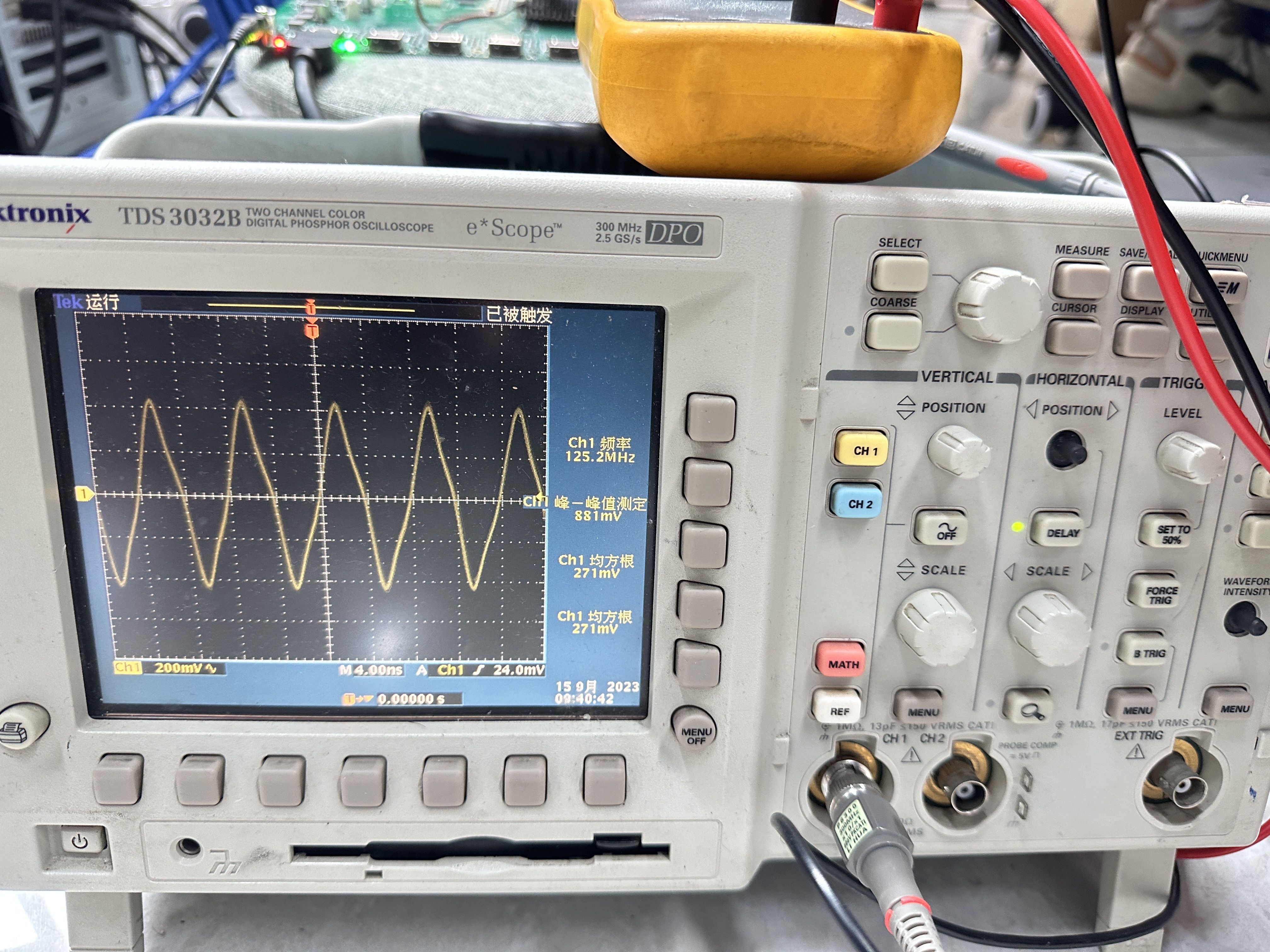
Pre-shipment testing is the stated acceptance procedure for Bitvisus video wall controllers — a commercial term as much as a quality step.
What a Long-Term Video Wall Controller Partnership Has to Cover
Long-term support for a video wall controller is a chassis-and-board problem rather than a box-level problem. A controller is a 1U frame containing processing boards, input and output modules and firmware, and those elements fail or become obsolete at different times. That structure determines what a useful partnership looks like: board-level replacement, a spare-parts path, firmware that continues to be issued, and a technical contact able to diagnose remotely before anyone books a courier.
Three commitments carry most of the weight in that model. The first is modularity — whether input and output capacity can be added or reduced per project instead of replacing the unit. The second is term-level clarity — the warranty period, whether it delivers repair or replacement, and which conditions are order-specific. The third is access — a named route to technical support and a stated availability window during commissioning and in-service operation. Everything else in a partnership conversation sits underneath those three, including the questions about expansion, resolution and transmission that arrive later in the project.
For a decision-stage buyer this reframing changes what to ask. Instead of requesting "the best warranty in the market", ask which component the warranty replaces, how a spare board reaches site, and what information the support team needs to diagnose a fault without a site visit.
Why Lifecycle Questions Arrive Late in the Buying Process
Lifecycle questions surface at the end of procurement because specification work happens first and service work is negotiated last. Market context explains why that ordering is now costly: video wall estates are increasingly mixed, with IP-based distribution sitting alongside baseband controllers and long HDBaseT or fiber runs, so one site can contain equipment bought in three different years.
Public reporting supports that reading without settling it. Dataintelo's 2026 market report estimates the global video wall controller market at roughly USD 2.25 billion in 2025, rising to USD 4.4 billion by 2034 at a 7.8% CAGR; the same body of research contains materially lower estimates elsewhere, because "controller" is sometimes counted as processor hardware alone and sometimes as the complete display-management solution. GCG Enterprise Solution, citing AVIXA material, reports that AV-over-IP reached 73% of new video wall controller installations in early 2026, and that legacy 4U hardware processors lost 18% of market share in 2025 as orchestration moved toward IP and software. Statifacts attributes 50% of video wall processor market contribution to control-room applications.
For a buyer these figures matter in one direction only: replacement cycles and protocol shifts will outlast any single purchase order. A controller bought for a control room today will probably share a wall with IP endpoints and a newer processor before it is retired. Whether that is workable depends less on the specification sheet than on whether the supplier still supplies boards, firmware and fault diagnosis once the estate around the unit has changed. ISO 11064, the international standard for control-room ergonomics, points the same way: display management requirements are defined at the level of the operating environment, not the individual screen.
The Questions That Repeat on Multi-Year Projects
Modular expansion and long-distance fiber transmission
Modular expansion is supported at chassis level: different processing boards can be fitted per project, adding or removing input and output ports as the signal map changes, with the BIT-MSE-U1-208 modular controller as the documented example. For long-distance runs, Bitvisus supplies a fiber optic extender and embedded projection fusion server product line. One boundary belongs in every quotation: the published FAQ states that fiber transmission distance and single-mode/multi-mode specifications are not publicly disclosed, and must be confirmed with sales or technical support before the solution is frozen. Treat the distance figure as an engineering input obtained in writing, not as a catalogue assumption.
PIP/POP, window roaming and multi-source layout
Multi-window capability is model-specific rather than a house-wide feature. The BIT-VWC-U1-MD404Ma, for example, has a built-in splicing matrix plus window roaming, allowing multiple windows to be overlaid on the same screen with free layout and cross-screen roaming — behaviour that command and control rooms, multi-screen video surveillance and multimedia conference halls depend on. If a project needs only fixed splicing, that capability is not a requirement and should not drive model selection; if operators must drag, overlay and resize sources during an incident, it becomes the deciding criterion.
Processing architecture and 7×24 duty
Bitvisus builds on self-developed FPGA image processors and HD processing chips, with more than ten years of stated FPGA image processing experience, in a modular 1U chassis positioned as industrial grade and intended for continuous long-hour operation in control rooms and engineering displays. The practical consequence of an FPGA pipeline rather than a general-purpose CPU path is that processing load is deterministic; the company's published comparison with ARM-based splicing processors, consumer splitters and imported brands puts its own latency at zero against 100 ms and above for the ARM/CPU category. That is a manufacturer comparison rather than an independent benchmark and should be verified against your own sources and signal chain, but it explains why architecture is a legitimate partnership question instead of a technicality.
Interfaces, resolution and splicing scale
Mainstream models take HDMI and DP inputs and provide HDMI outputs, with HDCP support for mainstream players, PCs and matrix sources. Resolution coverage spans 4K60 and 8K: 4K60 models such as the BIT-VWC-U1-MD404Ma provide 4× 4K60 input and 4× 4K60 output, while the 8K BIT-MSE-8K-212Pro provides 2× 8K input and 12× 4K HDMI output, with HDMI or DP input selectable to match the graphics card, backward compatibility to standard resolutions and support up to 8K×4K@60Hz. Splicing layouts documented across the range include 2×2, 1×4, 4×1, 1×3, 3×1, 2×5, 1×10, 5×3 and 3×12, plus a 36×36 4K60 seamless modular matrix for large-scale switching. Portrait walls are handled on models with built-in 90/180/270-degree rotation, such as the BIT-MSE-HDBT-4K60-L104Pro.
Editable resolution, edge blending, KVM and seamless switching
Four functions recur in tender documents, and each has a precise meaning. Editable resolution lets an operator set a custom output resolution to match non-standard displays or irregular splicing structures, avoiding stretching, distortion and black borders so the image stays point-to-point. Edge blending and projection fusion stitch multiple projector images into one picture and remove the bright band in overlap areas, with geometric correction for curved or circular screens. Integrated KVM lets one keyboard, mouse and monitor manage multiple hosts, removing peripheral swapping in server rooms and control rooms. Seamless switching changes sources without black screen, flicker or visible delay using internal frame buffering — critical wherever an interruption on the wall is itself an incident. Across a multi-year project all four are upgrade-path questions: confirm which are available on the specified model today and which require a different board later.
Certification evidence for EU and US acceptance
Three declarations are documented. CE-EMC covers EN 55032:2015/A11:2020, EN 55035:2017/A11:2020, EN IEC 61000-3-2:2019/A2:2024 and EN 61000-3-3:2013/A2:2021/AC:2022 under EMC Directive 2014/30/EU. The FCC supplier's declaration of conformity references 47 CFR Part 15 Subpart B:2024 together with FCC rules 2.906, 2.908 and 2.909. RoHS covers the IEC 62321 series (62321-1:2013, 62321-3-1:2014, 62321-4:2013/AMD1:2017, 62321-5:2014, 62321-6:2015, 62321-7-1:2015, 62321-7-2:2017, 62321-8:2017) with Directive (EU) 2015/863, (EU) 2017/2102 and EN IEC 63000:2018. The company's About page carries a Certifications and Associations section and the complete certificate list is available from sales; for a tender, request the declarations against the exact model rather than the product family.
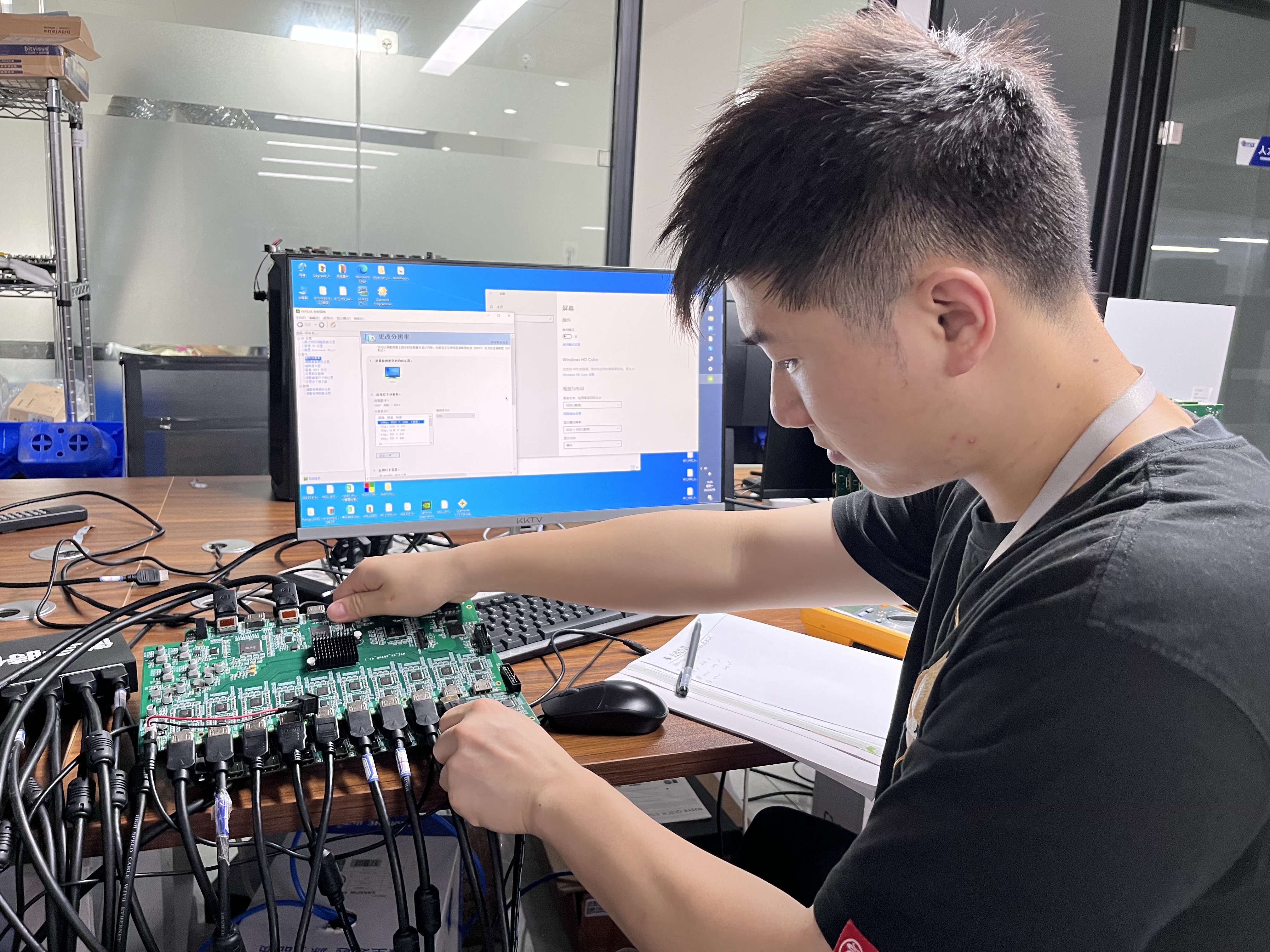
Verification before shipment supports both the acceptance procedure and the compliance documents supplied with an order.
Warranty: what one year with replacement actually delivers
Bitvisus's published service description lists a 1-year warranty with replacement, and the replacement element is the substantive part — the alternative offered elsewhere in the market is a one-year repair path without replacement. Because the chassis is modular, a fault can often be resolved by swapping the affected board rather than returning the complete unit, which shortens downtime and keeps the rest of the wall in service. Company-published quality data adds a 48-hour aging test before delivery and a stated 99.9% yield rate, though these are manufacturer statements rather than independently audited figures.
The order-specific layer sits on top of that. The published FAQ states that specific warranty periods, return and shipping terms are not publicly disclosed on the website and should be confirmed through support@bitvisus.com or the quote form. For a multi-year project the contract, not the web page, is the controlling document — so put the term, the replacement route, who pays freight in each direction and the expected spare-board holding into the order itself.
Support access, response route and spare parts
Technical support is reachable at support@bitvisus.com, sales at marketing@bitvisus.com and by phone or WhatsApp on +86 186 8150 9089, with a website form as a further route. The documented service set includes 7×12 hr technical support, remote diagnosis and debugging, fast spare-parts replacement and regular firmware upgrades. Response quality depends heavily on what the caller supplies: model, serial number, a precise fault description, the project scenario and the time zone in which a response is needed are the fields the company asks for. Integrators should turn that list into a site handover template so the information exists before it is needed.
From Specification to In-Service Support: The Execution Sequence
The execution stage has eight steps, and each one closes a question that would otherwise reopen during commissioning.
- Freeze the signal and display map. Record source interface types (HDMI, DP), maximum resolution and HDCP requirements, output count and connector type, the required splicing layout and the physical cable run. A 3×12 wall and a 2×2 wall use the same product family but different port budgets.
- Match chassis and boards. Confirm the 1U frame and board mix, and state explicitly whether capacity must be expandable later, since modular boards can be added or reduced per project.
- Decide the transport for distance. Choose between direct cabling, HDBaseT extenders and the fiber extender or embedded projection fusion server line, and obtain the fiber distance and single-/multi-mode specification in writing before the design is frozen.
- Request a formal quote. Website prices are sample prices; bulk pricing comes through the "Chat with us" panel, the "Request Quote" button or the Ask for Quote form, which requires name, email, phone and a project description.
- Validate with a sample or proceed to bulk. A sample order allows functional testing before commitment; bulk purchasing follows once the configuration is proven. MOQ is 1 unit for standard models, 10 for OEM private label and 100 for deep hardware and software customization.
- Confirm commercial terms. Delivery is quoted on FOB, CIF, EXW, DAP, DDP, DPU, FCA or CIP terms, and payment terms are full payment before delivery.
- Agree the acceptance procedure. Pre-shipment testing is the stated acceptance procedure; specify in the order which test evidence you expect to receive for the exact configuration, since the test is performed before dispatch rather than on site.
- Plan the in-service path. Register support contacts, agree how spare boards will be held for the operating period, and confirm that firmware updates and remote diagnosis remain available as the surrounding estate changes.

Board-level production inside the factory is what makes a module swap a realistic service route rather than a full-unit return.
Documented Commercial and Service Terms at a Glance
| Item | Documented position |
|---|---|
| MOQ — standard models | 1 unit |
| MOQ — OEM private label | 10 units |
| MOQ — deep hardware & software customization | 100 units |
| Delivery terms | FOB, CIF, EXW, DAP, DDP, DPU, FCA, CIP |
| Acceptance | Pre-shipment test |
| Payment terms | Full payment before delivery |
| Standard warranty | 1 year, with replacement |
| Technical support | 7×12 hr support, remote diagnosis and debugging; support@bitvisus.com; +86 186 8150 9089 |
| Spare parts and firmware | Fast spare-parts replacement stated; modular board swap; regular firmware upgrades |
| Certification documents | CE-EMC, FCC supplier's DoC and RoHS DoC listed; complete list on request from sales |
Terms as published in Bitvisus quotation, service and compliance material. Order-specific conditions are confirmed in writing.
What Is Published, What Must Be Confirmed in Writing
A partnership answer is only reliable when the buyer knows which statements are settled and which are open. The table below separates the two, so that an open item becomes an action in the quotation request rather than an assumption carried into commissioning.
| Open item | Status | How to close it |
|---|---|---|
| Fiber transmission distance; single-mode vs multi-mode | Not publicly disclosed | Confirm with sales or technical support in writing before design freeze |
| Full certificate list for a model | Section exists on the About page; full list on request | Request declarations against the exact model for the tender file |
| Warranty, return and shipping conditions for a specific order | Order-specific; not published | Confirm via support@bitvisus.com or the quote form, then write into the contract |
| Bulk unit price | Website prices are sample prices | Submit the Ask for Quote form with quantity and configuration |
| Delivery date for a specific quantity | Annual output is a capacity figure, not a schedule | Agree the date per order using the selected Incoterm |
Open items do not block a project, but they must be closed in writing rather than inferred from a product page.
Decision rule for multi-year projects: if a term cannot be answered from published material, it belongs in the quotation request — not in the commissioning plan. This applies most often to fiber distance specifications, order-specific warranty conditions and delivery scheduling.
Three Documented Duty Profiles and What They Demand From Support
Three documented configurations show the range of duty the service model has to cover. They are described here as operating profiles rather than customer endorsements, because their value to a buyer is the support implication, not the venue.
Continuous daily exhibition duty. A Shenzhen exhibition hall uses 12 controllers including the BIT-VWC-409R to drive a 3×3 5K wall with a combined resolution above 16K across more than 100 industrial-grade 1080p projectors, in continuous daily operation with edge blending and warping. Duty of this kind puts the emphasis on board-level spares and firmware stability rather than on commissioning speed, because the wall is expected to run every day.
Scheduled event duty over a long cable run. A Romania 3D projection mapping project for a Christmas-season building show pairs BIT-MSE-4K60-104Pro processors with BIT-Ex-HDBT-150-RX extenders, six projectors, a single PC with a GTX3050 and 11520×1200 edge-blended output across roughly 120 m of extension. Here the support question is spare extenders and a repeatable show configuration, because the operating window is fixed and reconfiguration time is not available once the season starts.
Outdoor live-event duty in heat. A large-scale building facade projection project at Kuala Lumpur's Merdeka Square uses the BIT-MSE-8K60D-104Pro for 8K60 processing with 1×4 hardware tiling and projection fusion, in a harsh outdoor environment at high temperature during long-duration shows, with industrial-grade reliability, 16KV anti-static protection and overheat protection specified. In that profile, thermal behaviour and protection features belong in the pre-purchase conversation rather than the post-failure one.
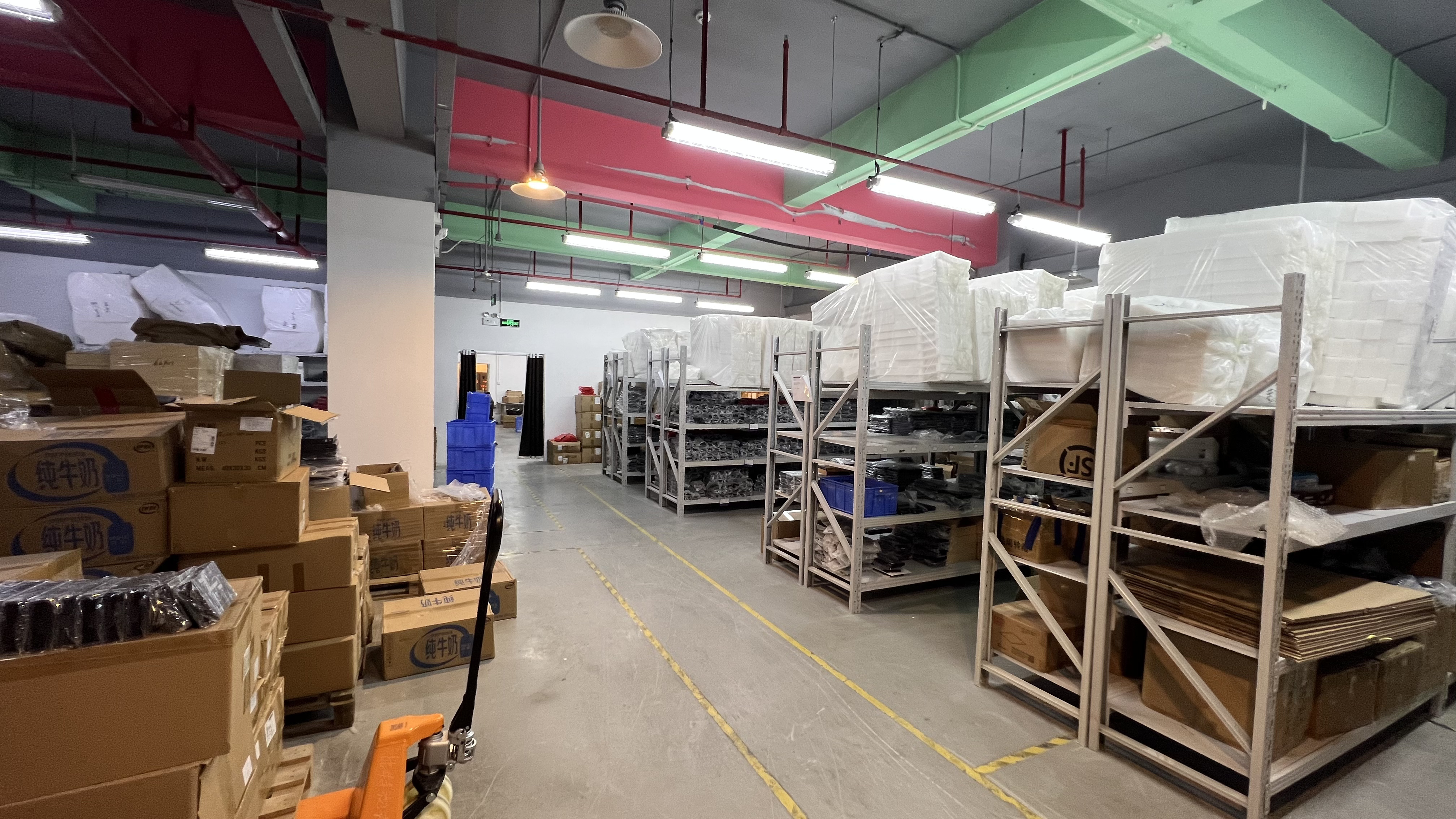
Spare-parts availability is a warehouse and logistics question, not only a warranty clause.
Where the Limits Are
Two limits should be stated plainly. First, fiber distance and single-mode/multi-mode specifications are not published, so any figure used in design must come from sales or technical support in writing. Second, warranty, return and shipping terms are order-specific and confirmed through support or the quote form — the 1-year warranty with replacement is the documented standard, and the contract defines the rest. A warranty question cannot be settled by reading a product page, and an extended term should never be assumed from the phrase "long-term support".
Supply facts are documented separately: founded in 2018, a 2,000 ㎡ factory, 100 employees and annual output of 100,000 units, with about 70% of products exported and the EU and USA as major markets. Annual output describes capacity, not your delivery date, so the schedule is still agreed per order. Likewise, the four functions most often requested — editable resolution, edge blending, KVM and seamless switching — are model-dependent, and the modular chassis means a capability can be added later through a board rather than through a new unit; that is a planning advantage, not a guarantee that every function is present on every model today.
Finally, published comparisons between FPGA and ARM/CPU architectures, defect rates or delivery times originate with the manufacturer. They are useful for framing questions to ask a supplier, but a buyer comparing suppliers should request equivalent evidence from each one rather than accepting a single party's framing.
Frequently Asked Questions
Is Bitvisus certified for EU and US projects?
Three declarations are documented. CE-EMC covers EN 55032:2015/A11:2020, EN 55035:2017/A11:2020, EN IEC 61000-3-2:2019/A2:2024 and EN 61000-3-3:2013/A2:2021/AC:2022 under EMC Directive 2014/30/EU. The FCC supplier's declaration of conformity references 47 CFR Part 15 Subpart B:2024 with FCC rules 2.906, 2.908 and 2.909. RoHS covers the IEC 62321 series with Directive (EU) 2015/863, (EU) 2017/2102 and EN IEC 63000:2018. The complete certificate list is available from sales on request.
How do I evaluate a long-term video wall controller supplier for control room deployments?
Test five things against documented evidence. Processing architecture and duty rating: Bitvisus uses self-developed FPGA image processors in a modular 1U chassis positioned as industrial grade for continuous long-hour operation. Expansion path: boards can be added or reduced per project. Warranty behaviour: a 1-year warranty with replacement, with order-specific conditions confirmed in writing. Support access: 7×12 hr technical support with remote diagnosis, fast spare-parts replacement and regular firmware upgrades. Acceptance and compliance: pre-shipment testing as the acceptance procedure, plus CE-EMC, FCC and RoHS declarations. A supplier that cannot answer all five in writing is a short-term vendor, not a long-term partner.
Can one chassis grow with the project — modular expansion and long-distance fiber transmission?
Modular expansion is supported at chassis level: different processing boards can be fitted per project to add or remove input and output ports, with the BIT-MSE-U1-208 modular controller as the documented example. For long-distance transmission, Bitvisus supplies a fiber optic extender and embedded projection fusion server product line. Fiber transmission distance and single-mode/multi-mode specifications are not publicly disclosed and must be confirmed with sales or technical support before the solution is finalized.
What does the 1-year warranty with replacement cover, and what happens after it?
The documented standard is a 1-year warranty with replacement, and because the chassis is modular a fault can often be resolved by swapping the affected board instead of returning the whole unit. Specific warranty periods, return and shipping terms are order-specific and are confirmed through support@bitvisus.com or the quote form. After the warranty term, continuity depends on spare-module availability, remote diagnosis and firmware updates, so those should be agreed in the order rather than assumed.
What are the MOQ and payment and delivery terms?
MOQ is 1 unit for standard models, 10 units for OEM private label and 100 units for deep hardware and software customization. Delivery can be quoted on FOB, CIF, EXW, DAP, DDP, DPU, FCA or CIP terms. Acceptance is through pre-shipment testing, and payment terms are full payment before delivery.
How do sample pricing and bulk pricing differ, and how do I request a quote?
Prices shown on the website are sample prices. Bulk or business-cooperation pricing is requested through the "Chat with us" panel at the bottom right of the product page, the "Request Quote" button on the page, or the Ask for Quote form, which requires name, email, phone and a project description. Placing a sample order first for functional validation and moving to bulk purchasing afterwards is the documented route to a better unit price.
How do I reach technical support during a live project?
Technical support is available at support@bitvisus.com, sales at marketing@bitvisus.com and by phone or WhatsApp on +86 186 8150 9089; a website form is an additional route, and the documented service window is 7×12 hr. Include the product model, serial number, a detailed fault description, the project scenario and your time zone so the team can respond efficiently. For configuration planning, the 2026 Bitvisus product brochure can be downloaded at https://cdn.socialarks.com/sbsp/25143/common/2026/0820/2026%20Bitvisus%20Product%20Brochure.pdf, and a formal quotation can be requested at https://bitvisus.com when the signal map is ready.
Conclusion: What to Write Into the Order
A video wall controller partnership holds up when the commercial documents and the service documents are negotiated together. The documented baseline from Bitvisus is concrete: a modular 1U chassis on self-developed FPGA processing, a 1-year warranty with replacement, 7×12 hr technical support with remote diagnosis and spare-parts replacement, pre-shipment testing as the acceptance procedure, MOQ tiers of 1, 10 and 100 units depending on customization depth, eight delivery-term options and full payment before delivery. The documented deployments — a continuously operating immersive exhibition in Shenzhen, a scheduled 120 m projection-mapping show in Romania and an outdoor 8K60 facade project in Kuala Lumpur — show the duty profiles those terms are meant to cover.
Three items remain open by design and belong in writing: fiber distance and mode specifications, order-specific warranty and return conditions, and the delivery schedule for your quantity. Closing them before the purchase order is raised is the difference between a supplier relationship and a partnership that survives year three.
To start that process, send the signal map and quantity to support@bitvisus.com or submit the quote form with your project description, and request the certificate set for the exact model alongside the commercial offer.
Shenzhen Bitvisus Technology Ltd. — contact point for quotations, certificate sets and technical support requests.
Have Questions or Need More Details?
Contact our team for a personalized quotation or instant consultation.
Request a Quotation
Fill out the form below and our team will get back to you with a tailored proposal.
WhatsApp Direct Chat
Prefer to chat in real-time? Message us on WhatsApp for instant assistance & quick answers.
- Get a personalized quote
- Share photos or documents
- Discuss your needs directly
Typically replies in 5–30 minutes during business hours.