
Video Wall Controller Signal Comparison: HDBaseT at 120 m vs Fiber Extender
Video Wall Controller Signal Comparison: HDBaseT at 120 m vs Fiber Extender
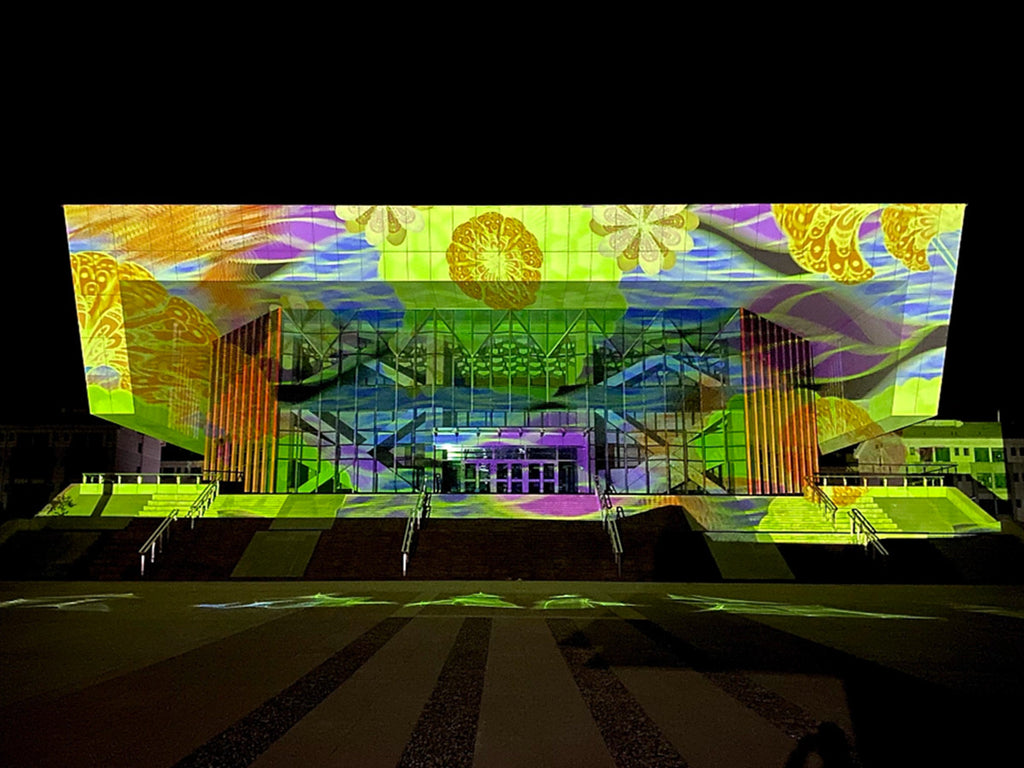
Romania 3D projection mapping benchmark: one 4K PC source, two BIT-MSE-4K60-104Pro multi-screen expanders and six BIT-Ex-HDBT-150-RX HDBaseT receivers over approximately 120 m.
In the Romania Christmas building-mapping project, one 4K PC source reached six projectors through two BIT-MSE-4K60-104Pro multi-screen expanders and six BIT-Ex-HDBT-150-RX HDBaseT receivers over roughly 120 m of cable — with no fiber in the signal chain. HDBaseT extension was sufficient because every projector link ran at 1920×1200@60Hz and the cable path stayed inside the extender's rated 150 m CAT6E run. Fiber becomes the correct question when a span exceeds that rated distance, leaves the building, or must carry more than a 1200p@60Hz-class payload.
This comparison is written for the stage where a video wall controller is already on the drawing and the transport layer still has to be locked: evaluation through execution. It follows the Romania deployment as a verified benchmark, then sets out where HDBaseT stops being enough, what to ask about modular expansion and long-distance fiber transmission, and the specification checklist — PIP/POP and window roaming, integrated KVM, and editable resolution — that should be answered before a controller is ordered.
Where the Signal Actually Leaves the Rack
A video wall controller makes two separate promises. Composition is the first: it takes sources and splits, tiles, edge-blends or windows them into the layout a venue needs. Delivery is the second: it hands each finished segment to a projector or panel over a physical link. Most signal discussion stops at composition, but the delivery link is what fixes cable schedules, commissioning hours and the list of things that can fail on site.
Copper HDMI has a short reach by design, and the published specifications say so. The 18-output BIT-VWC-218Pro lists HDMI output cable length at ≤15 m. The 8K60 BIT-MSE-8K60Y-104Pro lists HDMI 2.0 output copper at ≤10 m, and the BIT-MSE-8K60D-104Pro lists copper output at ≤5 m. A projector sitting 120 m from the rack therefore cannot be fed from a controller output directly. The last hop has to be extended, and the two production-grade options are twisted-pair HDBaseT extension and fiber extension.
They are not interchangeable at the margin. A CAT-based HDBaseT link is rated for a defined distance at a defined resolution, carries control signals back to the projector, and can deliver power in one direction. A fiber link answers a different problem set: longer spans, different electromagnetic exposure, and payload headroom for future upgrades. The Romania project is useful precisely because it is a documented case where the copper answer was sufficient — which makes the fiber threshold easier to define honestly.
Why the Transport Layer Moved Into the Specification
Market-level signals support treating transport as a specification item rather than an installation detail. Third-party tracking estimates the global video wall controllers market at approximately USD 2.25 billion in 2025, projected to reach USD 4.4 billion by 2034 (Dataintelo), with a CAGR of about 7.8% across 2025–2034 in the same source. Reported market sizes vary widely with definition — processor hardware alone versus a full display-management solution including software and integration — so any single headline figure should be read as definition-dependent rather than absolute.
Three structural shifts say more to a specifier. AV-over-IP reached 73% of new video wall controller installations in early 2026, according to GCG Enterprise Solution citing AVIXA. Control Room applications account for around 50% of video wall processor market contribution in a Statifacts estimate for 2025. And legacy 4U fixed-format hardware processors lost 18% market share in 2025 as buyers shifted toward network- and software-orchestrated architectures. The direction of travel is toward modular hardware plus a deliberately chosen transport layer, not toward a fixed box with fixed ports.
Two non-technical items land in the same project phase. Video wall controllers are commonly declared under HS code 85437099 (or 85437042) for customs purposes, and control-room video wall design is influenced by ISO 11064, the international standard for control-room ergonomics. Both are easier to handle when the copper-or-fiber decision is made before the cable tender, not after.
HDBaseT at 120 m: How the Romania Deployment Was Built
The reference project is a Christmas building 3D projection mapping light show, also used for museum building projection mapping in Romania. The equipment list is short: one PC with a GTX 3050 GPU, two BIT-MSE-4K60-104Pro multi-screen expanders, and six BIT-Ex-HDBT-150-RX HDBaseT receivers. Transmission distance was approximately 120 m. Six projectors were driven from the single PC, with three projectors per group fused into one blended image, producing a total resolution of up to 11520×1200. The project has a five-year duration.
The signal chain explains the result. The 4K source enters the expanders, which split the picture into per-projector segments; each segment then travels over CAT6E through an HDBaseT receiver to a projector. Running two BIT-MSE-4K60-104Pro units in parallel is what allowed one PC to feed six projectors while keeping each device inside its own output configuration.
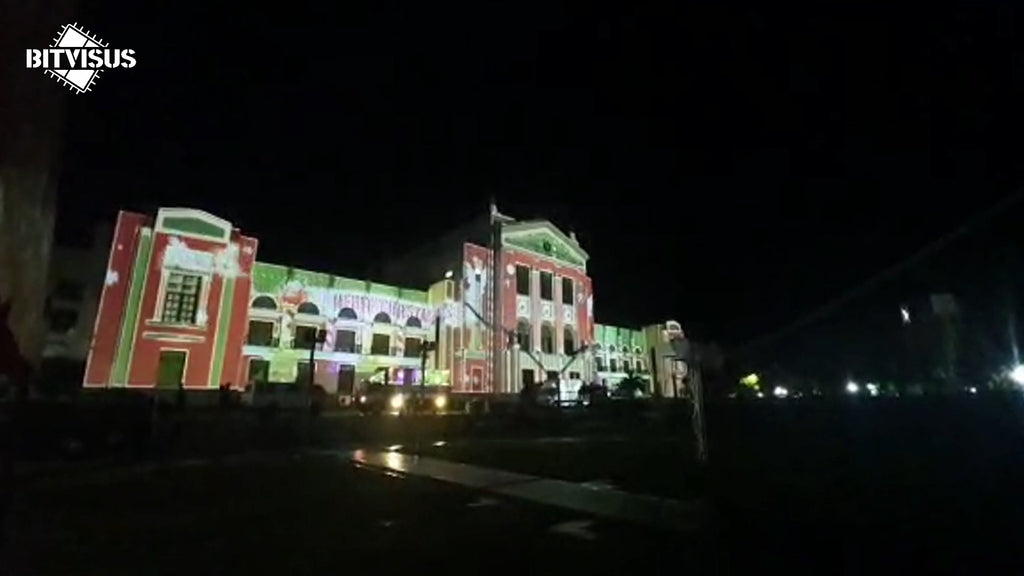
Distribution architecture: one 4K PC source, two expanders in parallel, six HDBaseT receivers, six projectors, roughly 120 m of CAT6E.
The BIT-MSE-4K60-104Pro specification sets the working envelope: HDMI or DP input (HDMI priority) with HDCP 2.2, a maximum input pixel clock of 600 MHz, a maximum output pixel clock of 300 MHz, and four HDMI outputs. Typical three-screen resolutions are 3×1920×1200@60Hz and 3×1920×1080@60Hz; four-screen resolutions are 4×1920×1200@60Hz and 4×1920×1080@60Hz. Factory default is 3840×2160@60Hz in 2×2 mode, with 2×2 up to 3840×2400@60Hz, 3×1/1×3 up to 1920×3600@60Hz or 5760×1200@60Hz, and 4×1/1×4 up to 1920×4800@60Hz or 7680×1200@60Hz. Output distance is stated at 15 m, and the unit runs on 12V@2A with a one-year warranty.
The receiving end is the BIT-Ex-HDBT-150 HDBaseT extender. On the transmitter side it accepts HDMI 1.4 (≤5 m) plus IR and RS232; the receiver side takes CAT6E over a 150 m run and outputs HDMI 1.4 (≤5 m). Resolution is 1200p@60Hz with downward compatibility, at a pixel bandwidth of 165 MHz / 300 MHz and a transmission bandwidth of 6 Gbps. HDCP 2.2 is supported alongside DVI 1.0 and VGA compatibility, with CEC, 3D, two-way RS232 transparent transmission, two-way IR transparent transmission, unidirectional power supply, and fixed or transparent EDID. It draws DC 12V 2A at ≤12 W, is specified for -10 to 50 °C storage and -25 to 55 °C operating conditions, weighs about 0.5 kg, and supports OEM.
Engineering caution worth carrying into any similar design: the extender is an HDMI 1.4, 1200p@60Hz device, and its 150 m rating is quoted at 1080p-class signal. The Romania link sat at approximately 120 m and worked. A design that needs a true 4K60 signal at each projector input over copper is a different calculation — the rated resolution and the rated distance must be checked together, not distance alone.
The reported outcome was fewer commissioning hours and lower project cost than the alternative of a separate controller per group, with two expanders operating in parallel.
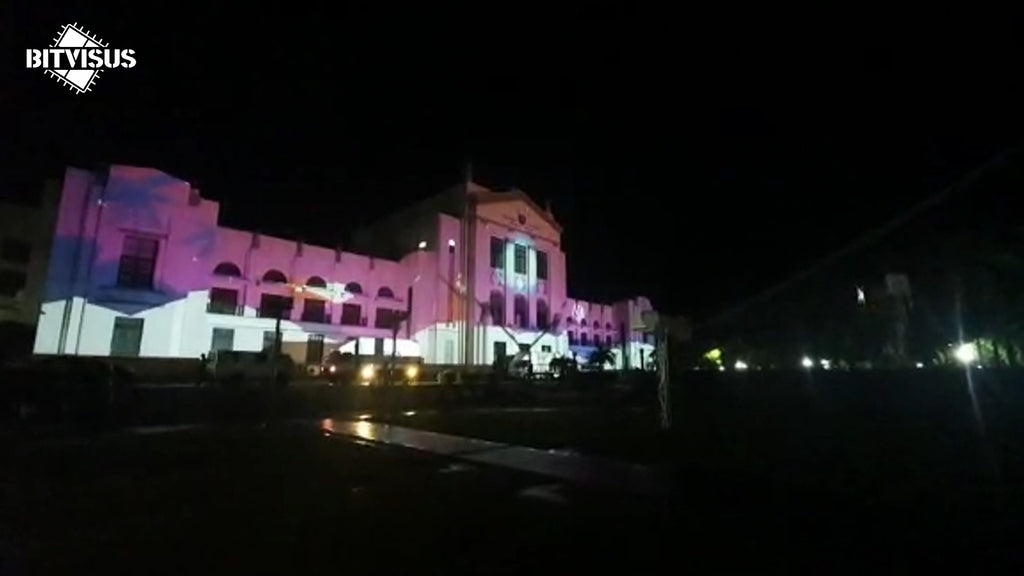
Result of the HDBaseT route: six projectors, three per blended group, total resolution up to 11520×1200.
When HDBaseT Is Sufficient — and When to Ask About Fiber
HDBaseT extension is normally sufficient when five conditions hold at the same time:
- Every display link stays inside the extender's rated distance. On the BIT-Ex-HDBT-150 that is a 150 m CAT6E run; the Romania project used approximately 120 m.
- Per-display payload stays in the 1080p/1200p @60Hz class — which is what a 1080p-class projector chain consumes.
- A control path to the projector is required: this extender passes RS232 and IR in both directions.
- Single-direction power delivery over the link simplifies on-wall power.
- Runs stay indoors, in conduit, and inside one building's grounding environment.
Fiber becomes the right question in four situations — and the specification detail belongs to the supplier:
- The cable path exceeds the rated CAT6E distance, or the designer wants margin against future re-routing.
- The link leaves the building or crosses a facade or campus, where surge exposure and grounding differ from an indoor run.
- One span must carry a heavier payload than the current 1200p@60Hz-class signal, or the venue expects a future 4K60-per-display upgrade on the same cable.
- Scale will grow — more projectors or panels added later on the same transmission infrastructure.
Bitvisus answers this at product-line level: the company offers a Fiber Optic Extender and an Embedded Projection Fusion Server line for long-distance signal transmission. Its published position is also explicit about the limit of what is public — the specific fiber transmission distance and single-mode/multi-mode specifications are not publicly disclosed, and should be confirmed with sales or technical support before a fiber link is written into a design. That is a normal pre-sales enquiry rather than a gap: fiber distance, connector type and mode depend on the project.
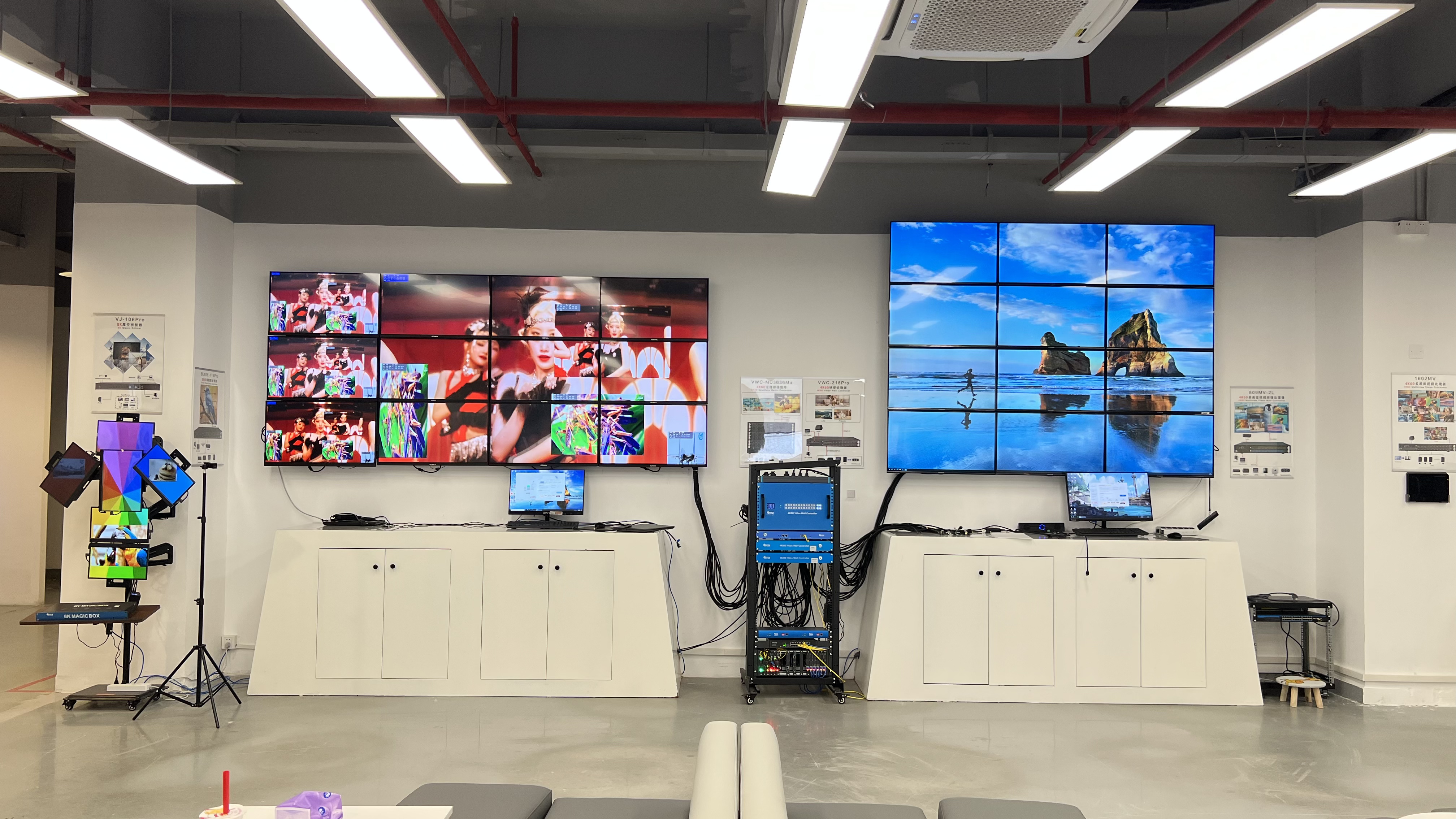
Modular expansion is the other question to raise at the same time. Bitvisus controllers use chassis that accept different processing boards per project, so input and output ports can be added or removed flexibly — the BIT-MSE-U1-208 modular controller is the documented example of this approach. For large-scale matrix switching, the BIT-VWC-MD3636Ma 4K60 seamless matrix splicer shows the ceiling: a 7U chassis with up to nine input boards and nine output boards, 36 HDMI 2.0 input channels and 36 HDMI 2.0 output channels, 600 MHz maximum input and output pixel clocks (with special resolutions customisable below 300 MHz input and 600 MHz output), 8-bit colour depth, RGB444/YUV444/YUV422/YUV420 formats, and control through RS232, WEB, a button board, remote control or WEB API. That is rack-mount hardware in the literal sense, which matters when the transport decision is made for a control room rather than a temporary event.
Step-by-Step: Locking the Transport Layer Before Purchase
The following sequence keeps the controller and the transport aligned, using only information a supplier can confirm in writing.
- Count sources and target pixels per display. In Romania the answer was one 4K PC source and six projectors, each receiving a 1920×1200-class segment for a total of 11520×1200.
- Set the controller output format per display. For the BIT-MSE-4K60-104Pro that means choosing between 4×1920×1200@60Hz, 4×1920×1080@60Hz, 3×1920×1200@60Hz and similar modes, and respecting the 600 MHz input / 300 MHz output pixel clock limits.
- Measure the real cable path, not the straight-line distance. Routing over a facade or around a hall adds length; the Romania figure of approximately 120 m is the installed distance.
- Choose the transport against a rated number. Direct HDMI copper is limited to the controller's stated output distance (≤15 m on BIT-VWC-218Pro, ≤10 m on BIT-MSE-8K60Y-104Pro, ≤5 m on BIT-MSE-8K60D-104Pro). CAT6E HDBaseT is rated at 150 m at 1080p-class on the BIT-Ex-HDBT-150. Anything beyond that rating is a fiber question.
- Decide one controller or parallel controllers. Two BIT-MSE-4K60-104Pro units ran in parallel in Romania to drive six projectors from one PC.
- Plan the control path. RS232, IR, WEB or WEB API control must be decided before installation; the BIT-Ex-HDBT-150 passes RS232 and IR transparently, and the BIT-MSE-4K60-104Pro plus the matrix range support RS232 and WEB control for remote management.
- Freeze resolution, EDID and layout before commissioning. EDID behaviour (fixed or transparent) on the extender and the controller output map should be documented, because changing either after installation is what consumes commissioning hours.
One procurement detail belongs with step seven: acceptance is handled through a pre-shipment test procedure, and production quality control runs a three-level process — 100% inspection of core components, single-board function testing, and a 7×24-hour full-channel power aging test on finished goods.
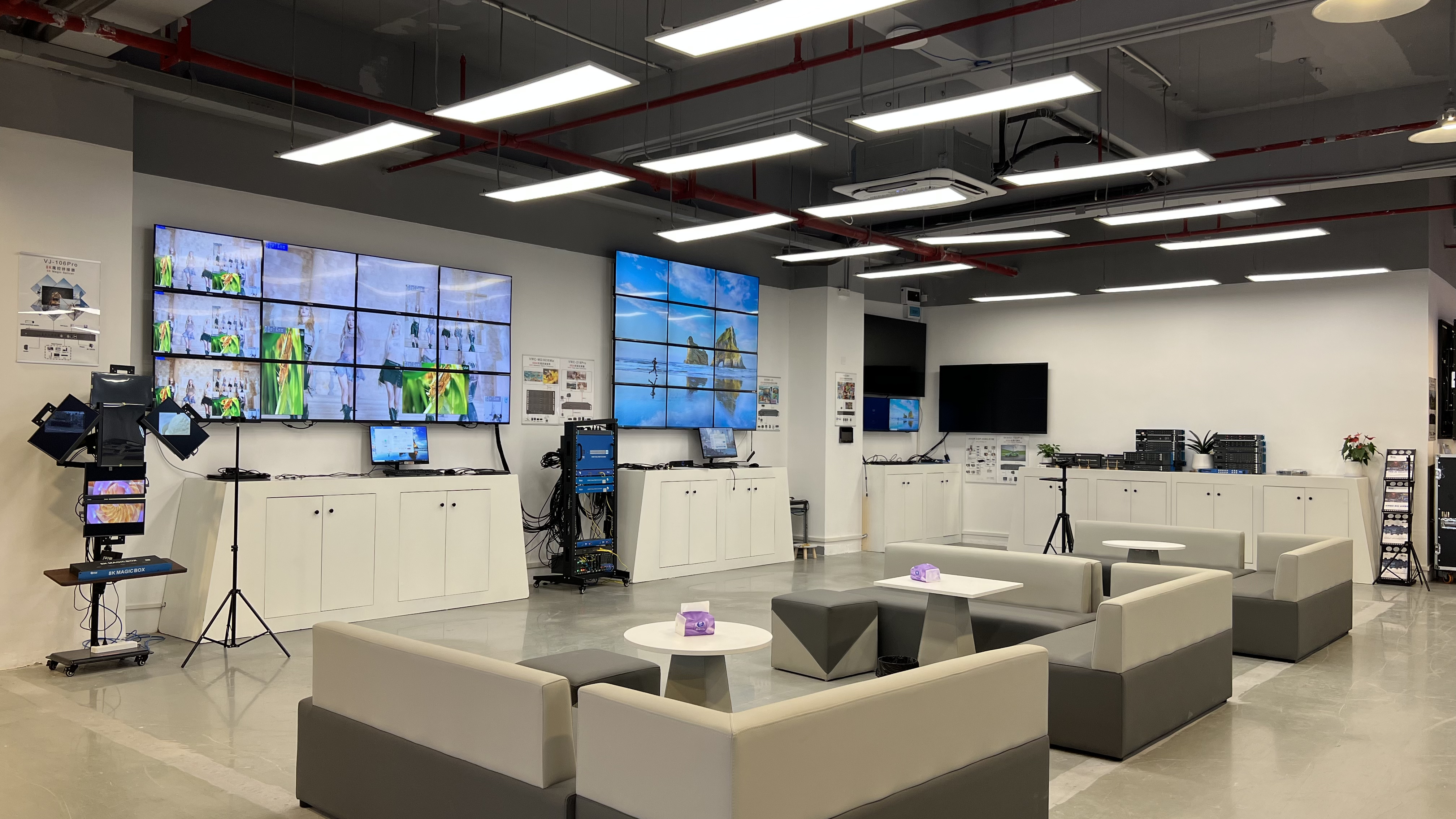
Pre-shipment verification: acceptance is handled through a pre-shipment test procedure, supported by a three-level QC process.
Specification Checklist: PIP/POP, Window Roaming, KVM and Editable Resolution
Transport decides whether pixels arrive. The feature set decides what those pixels can do once they are on the wall. Four capabilities belong in the pre-purchase conversation because they cannot be retrofitted later.
PIP / POP and window roaming
Multi-window overlay and cross-screen roaming are supported functions rather than assumptions. The documented example is the BIT-VWC-U1-MD404Ma, which combines a splicing matrix with window roaming: multiple windows can be overlaid on the same screen with free layout, and windows can roam across screens. That combination is what command-control rooms, multi-screen video surveillance installations and multimedia conference halls actually need.
Integrated KVM
Integrated KVM lets one keyboard, mouse and monitor centrally manage multiple sources or hosts, folding signal switching and device control into the same hardware. Matrices with KVM, such as the 4K60 seamless KVM HDMI matrix, are aimed at server rooms and control rooms where operators should not be re-plugging peripherals. The BIT-Ex-HDBT-150 also lists KVM among the signals it extends, so the KVM path can travel over the same CAT6E link as the video.
Editable resolution
Editable resolution means the output resolution can be set to custom, non-standard values. It exists for non-standard displays and irregular splicing structures, and it prevents the three failure modes buyers see most often — picture stretching, distortion and black borders — by allowing point-to-point mapping.
Rotation, switching and continuous operation
Portrait splicing and rotated output are available on multiple models; the BIT-VWC-409R, for example, can rotate the input by 90° and rotate the first output row by 180°, and supports PIP, parallel connection of multiple devices and multi-device cascading. Seamless switching without black screen or visible delay is available on matrix models such as the 36×36 and 12×12 range and the BIT-VWC-U1-MD404Ma. For control rooms, the processing architecture matters as much as the feature list: Bitvisus uses a self-developed FPGA image processing algorithm with pure hardware parallel processing and zero latency, in a modular 1U chassis class positioned for continuous long-hour operation — the basis of a low-latency video wall controller that can run 7×24.
Questions to put to any supplier before signing off a controller: Does the model support PIP/POP and cross-screen window roaming, and how many windows? Is KVM integrated, and how many hosts can one keyboard and mouse reach? Can the output resolution be edited to a non-standard value? Which models support 90/180/270-degree rotation? What is the processing architecture, and is the chassis intended for 7×24 operation? Does the model support web interface control and remote management?
Use Cases: Matching Transport to Venue
Building facade and architectural projection mapping. The Romania project is the reference for the CAT route: one PC, two expanders, six receivers, approximately 120 m, 11520×1200 total. A second Bitvisus reference from Malaysia uses a single BIT-MSE-8K60D-104Pro to drive four projectors with 1×1, 1×2, 1×3, 1×4 and 2×2 tiling modes for building facade projection mapping, national day celebrations and commercial plaza multimedia light shows — a compact, single-device version of the same architecture, and a genuine 8K video wall controller path for 8K60 sources.
Immersive exhibition halls. A Shenzhen immersive painting exhibition deployed 100+ industrial 1080p projectors and 12 Bitvisus video wall controllers, each BIT-VWC-409R driving nine projectors in a 3×3 wall. Each wall achieved 5760×3240, and multiple walls were recombined for a final image above 16K, over a five-year project duration. Scale like this is where modular chassis and documented board options matter more than any single specification.
Control rooms and security monitoring. Control Room applications account for around 50% of video wall processor market contribution in the 2025 Statifacts estimate, and ISO 11064 governs control-room ergonomics. This is the segment where integrated KVM, seamless switching, 7×24 FPGA-based operation and web interface control decide the choice, and where a rack-mount video wall controller (2U or 7U chassis) is a procurement requirement rather than a preference. A video wall controller for security monitoring also depends on multi-window overlay and patrol-style layouts, which is exactly what window roaming provides.
Conference rooms, education and commercial media. Smaller walls need fewer decisions. The BIT-VWC-218Pro offers 18 HDMI outputs at up to 1920×1200@60Hz for multi-display rooms; the BIT-MSE-4K60-104Pro covers four-output video wall controller for conference room and classroom layouts with RS232 or WEB control. For 8K sources, the BIT-VWC-8K60Y-115Pro accepts 8K60 over HDMI 2.1 or DP 1.4 and provides 15 HDMI 1.4 outputs at 1920×1200@60Hz or 1920×1080@60Hz, while the BIT-VWC-8K60-404Max accepts a five-channel 8K60 input card (HDMI 2.1, DP 2.1, Type-C DP 2.1) and outputs four HDMI 2.0 channels at 3840×2160@60Hz or 3840×2400@60Hz.
HDBaseT vs Fiber Extension: Comparison Table
| Decision factor | HDBaseT over CAT6E — BIT-Ex-HDBT-150 | Fiber extension — Bitvisus fiber extender / embedded projection fusion line |
|---|---|---|
| Rated transmission distance | 150 m over CAT6E at 1080p-class signal | Not publicly disclosed — confirm distance and single-mode / multi-mode specification with sales or technical support |
| Video interface | HDMI 1.4 at both ends, with cable ≤5 m at transmitter and receiver | Not publicly disclosed |
| Resolution ceiling on the link | 1200p@60Hz with downward compatibility | Not publicly disclosed |
| Signal bandwidth | Pixel bandwidth 165 MHz / 300 MHz; transmission bandwidth 6 Gbps | Not publicly disclosed |
| Control path over the same cable | Two-way RS232 and two-way IR transparent transmission; CEC; KVM listed among extended signals | Not publicly disclosed |
| Power | Unidirectional power supply; DC 12V 2A; ≤12 W power dissipation | Not publicly disclosed |
| Environmental rating | -10 to 50 °C storage / -25 to 55 °C operating | Not publicly disclosed |
| Proven deployment in this article | Romania building 3D projection mapping: approximately 120 m, six projectors, 2× BIT-MSE-4K60-104Pro plus 6× BIT-Ex-HDBT-150-RX, 11520×1200 | Fiber-specific distances are not published; long-span and cross-building links are the stated use case for the fiber extender and embedded projection fusion server lines |
| Best fit | Indoor runs inside the rated distance with 1080p/1200p per display, where a control back-channel to the projector is needed | Runs beyond the rated CAT6E distance, inter-building or facade links, or payload headroom for future upgrades |
| What to verify before ordering | Installed cable length, per-display resolution, EDID mode, extender count | Distance, single-mode or multi-mode, connector type, and the controller-side interface |
The table is intentionally asymmetric. The HDBaseT column is filled from published specifications; the fiber column is marked where Bitvisus does not publish the figure, because inventing a distance or a mode would be worse than asking.
FAQ
Which compliance documents ship with the controllers and extenders used in EU and US projects?
Bitvisus holds RoHS, CE-EMC and FCC Supplier's Declaration of Conformity declarations issued 11 May 2026 through Shenzhen Circle Testing Certification Co., Ltd. Two scopes are documented. The 220V-input modular multi-screen splicing matrix processor (MSE/VWC/MV series, lead model BIT-VWC-MD1212Ma) is covered by CTC118K0401302RC (RoHS), CTC118K0401302EC (CE-EMC) and CTC118K0401302FC (FCC). The 12V-input multi-screen splicing processor (MSE/VWC/MV series, lead model BIT-MSE-8K60D-104Pro) is covered by CTC118K0401301RC (RoHS), CTC118K0401301EC (CE-EMC) and CTC118K0401301FC (FCC). The RoHS declaration references the IEC 62321 series and EN IEC 63000:2018; the CE-EMC declaration references EN 55032:2015/A11:2020 and EN 55035:2017/A11:2020 under EMC Directive 2014/30/EU; the FCC declaration references 47 CFR Part 15 Subpart B and FCC rules 2.906, 2.908 and 2.909. Acceptance is by pre-shipment test.

CE-EMC declaration of conformity CTC118K0401301EC, issued 11 May 2026 for the 12V-input multi-screen splicing processor scope (MSE/VWC/MV series).
Do Bitvisus controllers support modular expansion and long-distance fiber transmission?
Yes on both counts, with one published limit. Modular expansion: the chassis can be fitted with different processing boards per project, so input and output ports can be added or reduced flexibly — the BIT-MSE-U1-208 modular controller is the documented example. Long-distance transmission: the company offers a Fiber Optic Extender and an Embedded Projection Fusion Server product line for long-distance signal transmission. Specific fiber transmission distance and single-mode/multi-mode specifications are not publicly disclosed, so confirm them with sales or technical support before finalising a design.
Do the controllers support PIP/POP, window roaming, integrated KVM and editable resolution?
PIP/POP and window roaming: yes — for example the BIT-VWC-U1-MD404Ma has a built-in splicing matrix with window roaming, allowing multiple windows to be overlaid on the same screen with free layout and cross-screen roaming. Integrated KVM: yes on KVM-equipped matrices such as the 4K60 seamless KVM HDMI matrix, where one keyboard, mouse and monitor manage multiple sources or hosts; the BIT-Ex-HDBT-150 also extends KVM alongside HDMI, IR and RS232. Editable resolution: yes on models that support it — output resolution can be customised for non-standard displays and irregular splicing structures, avoiding stretching, distortion and black borders.
How do I get a quote, and how does sample pricing differ from bulk pricing?
Prices shown on the Bitvisus website are sample prices. Bulk and cooperation pricing requires a quote request, submitted through the chat window on a product page, the Request Quote button, or the quote form (name, email, phone and project description required). Providing the target model, quantity, input/output configuration, customisation needs, delivery terms and shipping requirements produces an accurate offer. The usual route is to validate function with a sample order and then move to bulk pricing once the configuration is confirmed — which is also when delivery terms for export orders (FOB, CIF, EXW, DAP, DDP, DPU, FCA or CIP) are fixed.
What is the minimum order quantity, and how quickly can a sample or project order ship?
Standard models have a minimum order quantity of 1 unit; OEM private-label orders start at 10 units; deep hardware and software customisation starts at 100 units. Standard stock items ship in 3–7 days, custom orders take 2–3 months, and export orders are cleared and shipped within 10 days. Production capacity is 8,000 units per month from a self-owned 2,000 m² workshop with integrated SMT, assembly and aging test lines, backed by a three-level QC system covering 100% inspection of core components, single-board function testing and a 7×24-hour full-channel power aging test. Every unit carries a one-year warranty with 7×24 technical support, free remote debugging, fast spare parts replacement and localized technical training. To move from comparison to a sample configuration, send the projector count, measured cable distances and required features to the team — a project-specific quote and the 2026 Bitvisus product brochure can be requested through the channels below.
Conclusion
HDBaseT over CAT6E is not a compromise at 120 m — it is the documented choice in a five-year projection mapping project where two BIT-MSE-4K60-104Pro expanders and six BIT-Ex-HDBT-150-RX receivers carried a single 4K PC source to six projectors at 11520×1200. The condition that made it work is the one to test in every new design: per-display resolution inside the 1200p@60Hz class, and cable length inside the extender's rated run. Beyond that boundary, ask about fiber — and expect the distance and mode specifications to come from the supplier rather than a public page. Ask about modular board expansion at the same time, because the chassis decision is the one that cannot be reversed on site. Finally, close the feature list before ordering: PIP/POP and window roaming, integrated KVM, and editable resolution are the three items most often assumed and least often verified.
Next Step: Sample, Quote or Configuration Review
Send the venue layout, the measured cable path and the required per-display resolution, and the Bitvisus team will return a controller-plus-transport configuration with the output resolution map and the extender count for your project.
Sales and project enquiries: Eddie, eddie.jia@bitvisus.com, Tel / WhatsApp +86 186-8150-9089. Technical support: support@bitvisus.com. Product information: bitvisus.com. Download the 2026 Bitvisus Product Brochure.
Have Questions or Need More Details?
Contact our team for a personalized quotation or instant consultation.
Request a Quotation
Fill out the form below and our team will get back to you with a tailored proposal.
WhatsApp Direct Chat
Prefer to chat in real-time? Message us on WhatsApp for instant assistance & quick answers.
- Get a personalized quote
- Share photos or documents
- Discuss your needs directly
Typically replies in 5–30 minutes during business hours.