
Ranking Video Wall Controller Setups for Immersive Art & Projection Mapping: Proven Deployments
Ranking Video Wall Controller Setups for Immersive Art & Projection Mapping: Proven Deployments
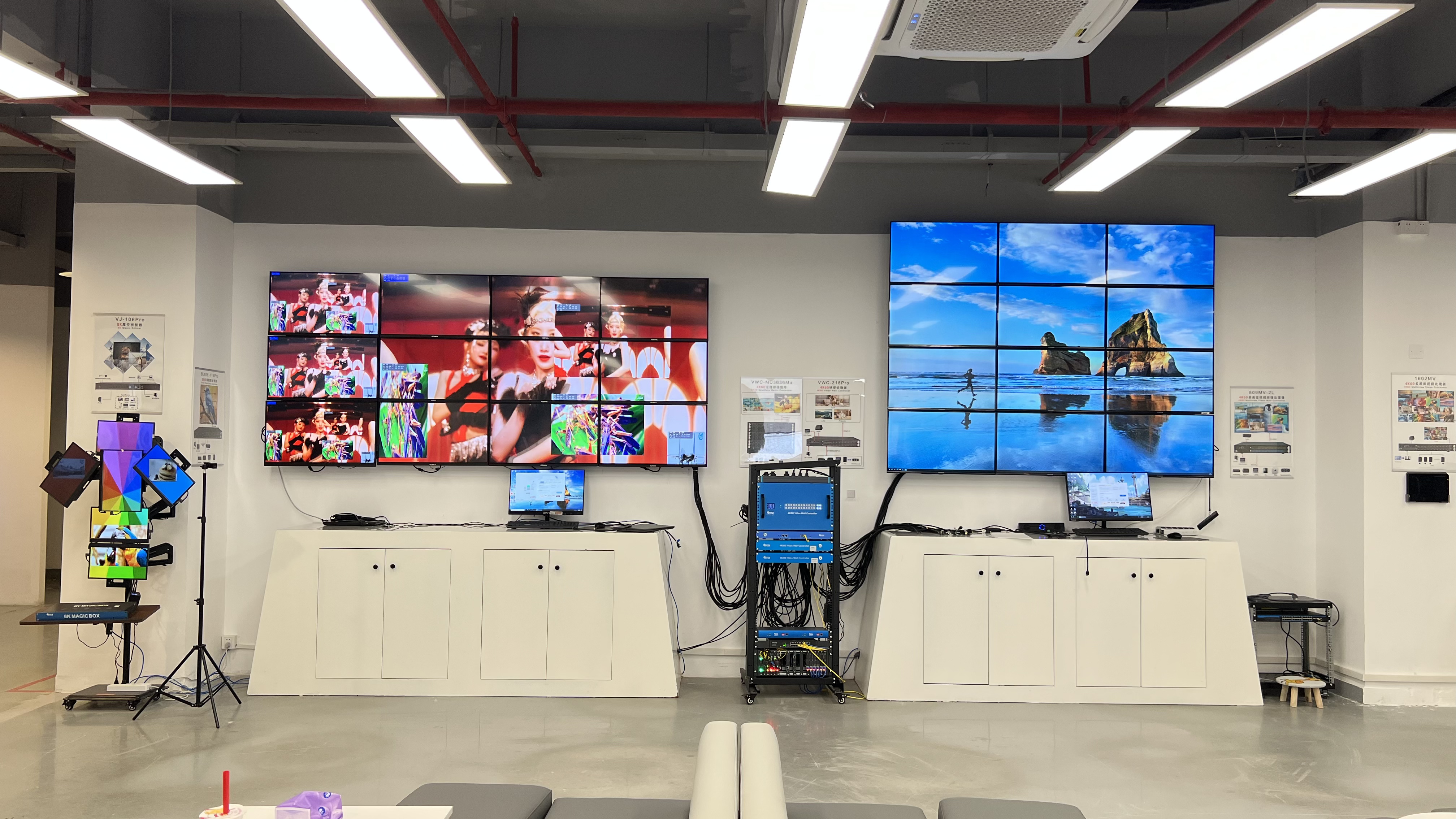
Bitvisus showroom, Shenzhen: the demonstration area where controller and projection processing configurations are assembled before shipment.
Immersive art and building-scale projection mapping are decided long before the first projector is hung. They are decided at the video wall controller layer: how many projectors one source can feed, whether overlapping projector edges blend into a seamless image, whether warping follows a curved wall or a building facade, and whether the system can be started again every morning for years. This article ranks two documented Bitvisus video wall controller setups built for exactly that kind of work, and explains the selection reasons behind each one.
Rank 1 — 12 × BIT-VWC-409R video wall controllers driving more than 100 industrial-grade 1080p projectors in the Shenzhen Cézanne immersive art exhibition, arranged as a 3×3 5K (5760 × 3240) wall with recombined images beyond 16K, in continuous daily operation across a five-year deployment.
Rank 2 — 2 × BIT-MSE-4K60-104Pro multi-screen expanders plus 6 × BIT-Ex-HDBT-150-RX extenders, carrying one 4K PC source (GTX 3050 GPU) to six projectors over roughly 120 m of HDBaseT for a Romania Christmas building projection mapping show.
Both setups were ranked on the same criteria: scalability to the required projector count, seamless edge blending and warping, signal distance, duty cycle and service life, commissioning effort, and reported project cost.
Bitvisus (Shenzhen Bitvisus Technology Ltd.) is a Shenzhen-based manufacturer of 4K/8K image and video processing hardware, including video wall controllers, multi-screen expanders, projector fusion processors, video processors, HDMI matrices, multi-viewers, and network and fiber extenders.
The short answer for specifiers: a permanent immersive exhibition with an ultra-large, high-resolution canvas calls for a distributed multi-controller wall (the Rank 1 pattern). A building facade or seasonal 3D projection mapping show with a long cable run and a single PC source calls for a compact expander-plus-extender topology (the Rank 2 pattern). The two deployments below are the documented basis for both rules.
Why Immersive Art and Projection Mapping Stress a Video Wall Controller Differently
In a conventional control room video wall, the controller's work is mostly to switch sources and tile them across fixed LCD panels in a grid. Immersive art and projection mapping add three burdens on top of that: geometry, synchronization and time.
Overlapping projector outputs have to be blended so that no brightness seam is visible, and the image has to be warped onto surfaces that are not flat — curved walls, columns, irregular objects, or the facade of a building. Every output also has to stay in sync, because moving content that tears between two projectors is immediately visible to an audience standing inside the projection.
The failure modes are audience-visible: a light band where two projectors overlap, warping errors that break the illusion on a curved surface, one projector dropping out mid-show, or a processor that has to be rebooted during exhibition hours. For a permanent exhibition the same hardware must remain stable across years of daily operation; for an outdoor building show, it must survive repeated scheduled night-time show cycles.
Cost and commissioning are the second half of the problem. A topology that needs one dedicated processor per projector produces more devices, more rack space, more cabling and more commissioning hours — and commissioning is usually the least flexible part of an exhibition schedule. The two ranked deployments show the two ends of that trade-off, and both were selected for edge blending, warping, scalability, long-distance signal distribution, and reported lower project cost and reduced commissioning.
Industry Background: A Growing Market That Still Buys Deterministic Hardware
The global video wall controllers market was estimated at approximately USD 2.25 billion in 2025 and is projected to reach USD 4.4 billion by 2034, according to Dataintelo's video wall controllers market report. The same report gives a CAGR of 7.8% for the 2025–2034 period.
Transport and control are changing. GCG Enterprise Solution, citing AVIXA material, reports that AV-over-IP reached 73% of new video wall controller installations in early 2026, and that legacy hardware video wall processors in 4U chassis lost 18% of market share in 2025 as users shifted toward AV-over-IP and software orchestration. Control-room applications still account for roughly 50% of the video wall processor market contribution, according to Statifacts.
For immersive venues, that shift does not remove the need for hardware image processing. Edge blending, geometric warping and frame-accurate multi-projector synchronization are per-frame processing tasks. Bitvisus FPGA and embedded full-stack controllers process at 0 ms latency, compared with 100–300 ms on ARM/CPU software-processing splicing processors, and they support native 8K@60Hz with lossless color, compared with 4K@30Hz compressed and color-loss output on ARM-based controllers and low-end consumer splitters. Both deployments ranked below rely on dedicated hardware processing rather than software-only orchestration.
Board-level detail of Bitvisus processing hardware. Blending, warping and multi-output synchronization are handled in dedicated image processing rather than on a general-purpose CPU.
The Two Ranked Setups at a Glance
- Rank 1 — Distributed multi-controller wall (Shenzhen, China). 12 × BIT-VWC-409R video wall controllers (4-input, 9-output rotation splicing), fed from a PC with blending and warping software, driving more than 100 industrial-grade 1080p projectors. 3×3 video wall at 5K (5760 × 3240); recombined image beyond 16K. Continuous daily exhibition operation across five years.
- Rank 2 — Long-distance single-source mapping (Romania). 2 × BIT-MSE-4K60-104Pro multi-screen expanders with 6 × BIT-Ex-HDBT-150-RX extenders, one 4K PC source with a GTX 3050 GPU, six projectors, HDBaseT signal distribution over approximately 120 m, high-resolution edge blending and warping at 11520 × 1200. Event-driven scheduled shows during the Christmas season, outdoors at night.
Rank 1 — 12 × BIT-VWC-409R Controllers for a Shenzhen Immersive Art Exhibition
RANK 1 · ULTRA-LARGE CANVAS · CONTINUOUS DUTYWhat the deployment required
The venue is a large-scale immersive projection exhibition inside an exhibition hall in Shenzhen, China. The room is built as a 3×3 video wall at 5K (5760 × 3240), with recombined images beyond 16K and more than 100 industrial-grade 1080p projectors. It is not a temporary installation: the exhibition runs continuously, every day, and the controller architecture has been in service for five years.
How the setup is built
Twelve BIT-VWC-409R video wall controllers act as the distribution and tiling layer. Each unit is a 4-input, 9-output rotation-splicing controller, so a single unit maps naturally onto a 3×3 projector cluster. Feeding those clusters from a PC and driving them with blending and warping software produces one continuous canvas: edge blending removes the overlap bands where projector outputs meet, and warping corrects geometry so the image reads correctly across the full surface. Groups are then recombined so that the total image exceeds 16K.
Why it ranks first
- Scale: 12 controllers and more than 100 projectors is the largest of the two documented deployments, and capacity is expanded by adding controllers rather than by replacing the processing core.
- Resolution ceiling: 3×3 clusters at 5760 × 3240 each, recombined beyond 16K — the kind of canvas that immersive art direction depends on.
- Duty cycle and service life: continuous daily exhibition operation over five years, which is where industrial-grade hardware is separated from consumer-grade processing.
- Reliability math: Bitvisus industrial video wall controllers are rated for 7x24 continuous operation with a defect rate below 0.1%, compared with 0.5%–1% for ordinary ARM architecture splicing processors and low-end consumer splitters. Every unit completes a 48-hour aging test before delivery, versus 2–8 hours for those categories, with a reported 99.9% yield rate.
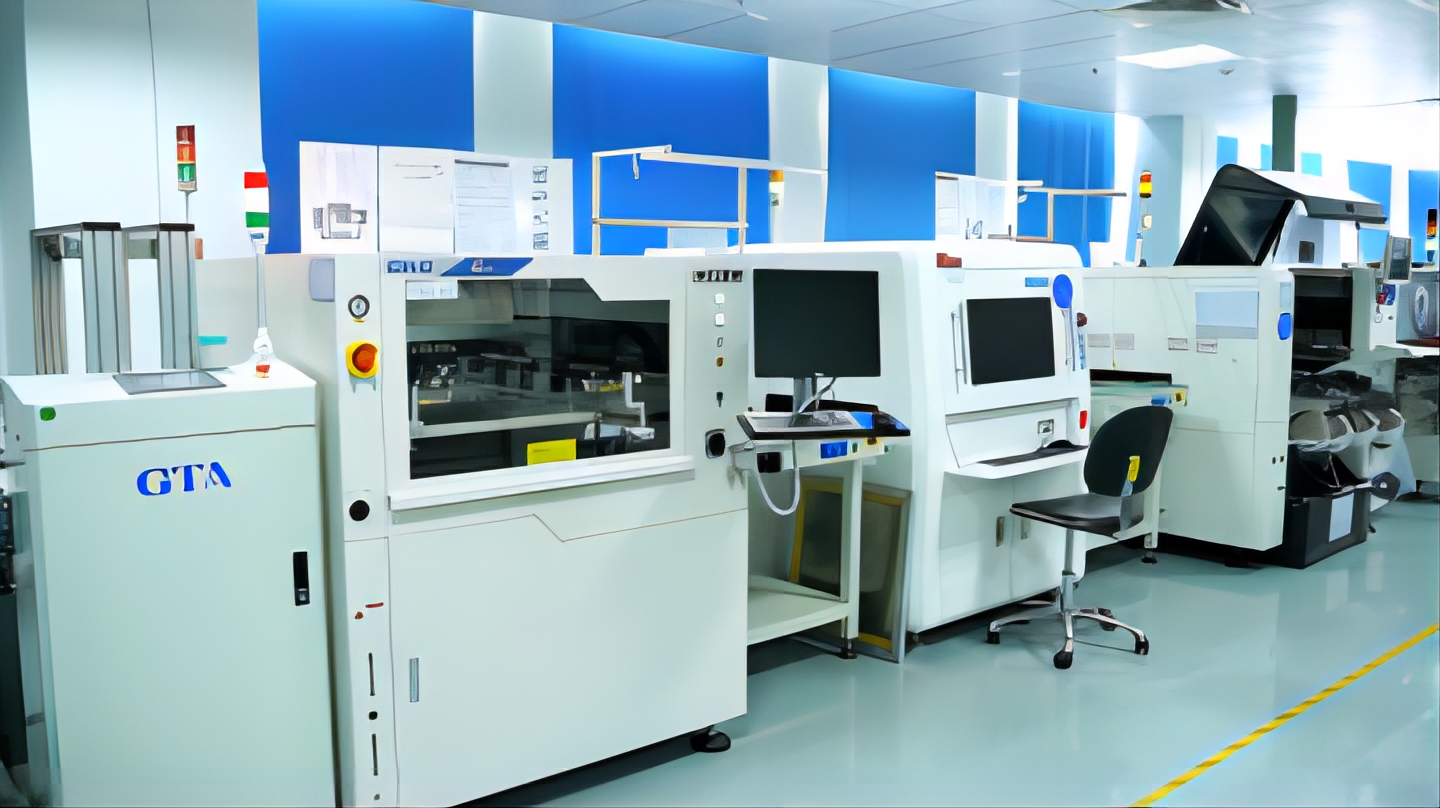
SMT production at Bitvisus. Multi-controller builds such as a 12-unit installation depend on repeatable board-level production rather than one-off assembly.
Trade-offs to plan for
Rank 1 is a large installation, and that has real planning consequences: twelve chassis to rack, more cabling, and a commissioning sequence that has to cover blending and warping for every cluster. A project that only needs one 3×3 5K wall does not need twelve units. A single BIT-VWC-8K60Y-115Pro accepts 8K60 input over HDMI 2.1 or DP 1.4 and provides 15 HDMI outputs, and it supports a 3×3 layout at 5760 × 3240@60Hz in RGB444 — one box where the Shenzhen project needed a distributed group.
Rank 2 — 2 × BIT-MSE-4K60-104Pro + 6 × BIT-Ex-HDBT-150-RX for a Romania Building Projection Mapping Show
RANK 2 · LONG-DISTANCE SINGLE-SOURCE MAPPINGWhat the deployment required
The Romanian project was a 3D projection mapping competition and building facade light show built around a six-projector system, running scheduled shows outdoors at night during the Christmas season. The control position sat roughly 120 m away from the projectors, so both image distribution and signal transport had to be solved in the same design.
How the setup is built
A single PC with a GTX 3050 GPU generates the 4K source. Two BIT-MSE-4K60-104Pro multi-screen expanders split and route that source, and six BIT-Ex-HDBT-150-RX extenders carry the signals over HDBaseT to six projectors across approximately 120 m, supported by projection lenses and mapping software. The result is one PC controlling six projectors with high-resolution edge blending and warping at a composite 11520 × 1200.
Why it ranks second — and why that is a fit decision, not a downgrade
Rank 2 solves a different problem with far fewer parts. Two expanders and six extenders replace a rack of processors; the single PC becomes the only content source to manage; the long cable run is handled at the extender layer rather than by moving the processing rack closer to the projectors. The project reported lower project cost and reduced commissioning as a result. It ranks below the Shenzhen deployment on scale and duty cycle rather than on image quality: six projectors in event-driven scheduled shows, instead of more than 100 projectors in daily continuous operation.
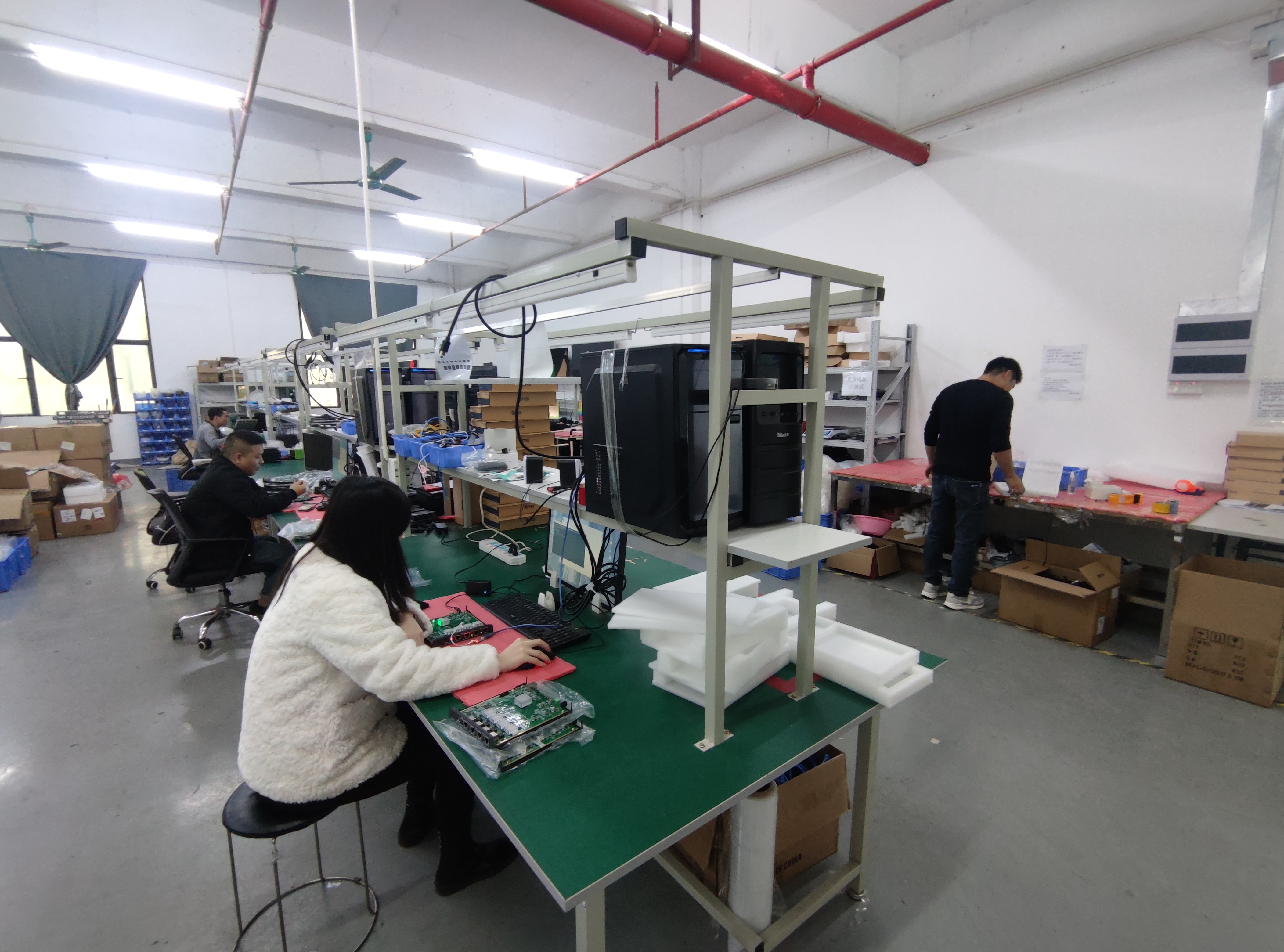
Assembly and rack integration at Bitvisus. Compact expander-plus-extender topologies reduce the number of devices a projection mapping crew has to install, power and commission on site.
Trade-offs to plan for
Channel count in this topology is fixed by the number of expanders and extenders: adding projectors means adding distribution hardware. The HDBaseT path covered roughly 120 m in this project; if a venue's cable run is longer than the chosen transport can carry, the transport layer has to change (see the FAQ on long-distance distribution below).
How the Ranking Was Built: Six Selection Criteria
- Scalability and channel count. Can the architecture reach the projector count the artwork requires, and can it grow later? Rank 1 scales by adding BIT-VWC-409R units; Rank 2 scales by adding expanders and extenders.
- Seamless image quality. Edge blending and geometric warping have to work across every overlap and every non-flat surface in the venue. Both deployments were selected for this capability first.
- Signal distance and topology. Where does the processing rack sit relative to the projectors? Rank 1 assumes a local, high-density rack; Rank 2 exists because the run was approximately 120 m.
- Duty cycle and service life. A permanent exhibition is a 7x24 requirement; a seasonal show is event-driven. Both were specified on industrial-grade hardware rated for 7x24 operation.
- Commissioning effort and cost. Fewer devices mean fewer commissioning hours. The Romania project reported reduced commissioning and lower project cost with its two-expander topology.
- Lead time and support. Delivery is approximately 7 days for Bitvisus controllers, compared with 15–30 days for imported brand and low-end alternatives, with remote diagnosis and debugging supported through 7×12 hour technical support.
Specifying Your Own Setup: A Five-Step Breakdown
Step 1 — Count projectors and clusters. Define the canvas first: how many projectors, how they group (3×3, 1×4, 2×2 and similar layouts are all supported across the range), and what resolution each cluster must reach. The Shenzhen project worked in 3×3 clusters at 5760 × 3240; the Romania project worked with six individual projectors on a facade.
Step 2 — Choose the topology. For a permanent, ultra-large, high-resolution canvas, specify a distributed multi-controller wall (Rank 1 pattern). For a single-source show with a limited projector count and a long cable run, specify an expander plus extender topology (Rank 2 pattern).
Step 3 — Measure the cable run and match the transport. Short copper HDMI/DP links cover local racks — for example, the BIT-VWC-218Pro accepts HDMI 2.0 and DP 1.2 input over copper up to 3 m and outputs 18 HDMI 1.3 channels over copper up to 15 m. HDBaseT handled approximately 120 m in the Romania building projection. For runs beyond that, Bitvisus offers a fiber optic extender line and an embedded projection fusion server line; published fiber distances and single-mode/multi-mode specifications are not disclosed publicly, so confirm them with sales or technical support before the cable plan is frozen.
Step 4 — Specify blending, warping and control. The current controller range is controlled over RS232 serial and a Web interface, and modular chassis such as the BIT-MSE-U1-208 modular controller accept different processing boards so input and output ports can be added or reduced as the project changes. Blending and warping are commissioned with the content software and the PC source, as in both ranked deployments.
Step 5 — Validate before the venue opens. Every Bitvisus unit completes a 48-hour aging test before delivery, with a reported 99.9% yield rate. Remote diagnosis and debugging plus regular firmware upgrades allow a configuration to be checked before show load-in, and controllers ship with a 1-year warranty.
Reference configurations for immersive and projection mapping projects
| Model | Type | Key specifications | Typical role |
|---|---|---|---|
| BIT-VWC-409R | Video wall controller | 4-input / 9-output rotation splicing | Distributed wall groups — 12 units drove 100+ projectors in the Shenzhen exhibition |
| BIT-VWC-8K60Y-115Pro | 8K60 video wall controller | 1× HDMI 2.1 + 1× DP 1.4 input; 15× HDMI 1.4 output; 3×3 at 5760 × 3240@60Hz RGB444; RS232 and Web control; 48 W | Single-controller 3×3 5K walls and medium immersive canvases |
| BIT-VWC-218Pro | 4K60 video wall controller | 2× HDMI 2.0 + 2× DP 1.2 input; 18× HDMI 1.3 output; up to 1920 × 1200@60Hz per output; RS232 and Web control; 48 W; 440 × 200 × 60 mm | Dense output counts in rack-mount installations |
| BIT-VWC-8K60-404Max | 8K60 video wall controller | 2U chassis; up to 5 input channels on HDMI 2.1, DP 2.1 or Type-C; 4× HDMI 2.0 output at 3840 × 2160@60Hz; 40 W | 8K source projects with modular input boards |
| BIT-MSE-8K60D-104Pro | 8K60 multi-screen expander | 1× DP 2.1 input; 4× HDMI 2.0 output; 2×2 at 7680 × 4320@60Hz and 1×4 at 15360 × 2160@30Hz; 28 W | Compact multi-projector splitting in the expander-plus-extender pattern |
Use Cases: Which Setup Fits Which Venue
- Permanent immersive exhibition halls and museums (Rank 1 pattern). Continuous daily operation, ultra-large canvases, curved projection fusion, digital exhibition halls, super-wide display walls and science museum installations all share the same requirement set: many projectors, one blended image, years of service.
- Building facade and 3D projection mapping shows (Rank 2 pattern). Seasonal or event-driven shows with a single content source, a project team working from a temporary control position, and a long cable run to the projectors.
- Theme parks, cultural tourism venues and VR ring cinemas. Either pattern applies, depending on whether the venue is a permanent daily operation or a scheduled-show environment.
- Adjacent duties for the same hardware family. The same industrial-grade controllers are used for control room video walls in command and dispatch centres, security monitoring walls, conference and meeting-room displays, smart classrooms, retail and transit advertising screens, and industrial monitoring dashboards. Rack-mount chassis range from compact 1U/2U-class units up to the 7U BIT-VWC-MD3636Ma seamless matrix splicer with up to 36 HDMI 2.0 inputs and 36 HDMI 2.0 outputs.
Where these two patterns do not fit: both ranked deployments use dedicated point-to-point processing with blending and warping handled in hardware. If a venue's architecture is IP-based, the transport and control layers change, and the controller's blending, warping and synchronization role remains the part that has to be specified carefully. Transport choice should follow the venue's cabling reality, not the other way around.
Comparison Table: The Two Ranked Setups Side by Side
| Rank | Deployment | Controllers and distribution | Source | Display scale | Duty cycle | Best fit |
|---|---|---|---|---|---|---|
| 1 | Shenzhen immersive art exhibition (China) | 12 × BIT-VWC-409R (4-in / 9-out rotation splicing); blending and warping software | PC source | 100+ industrial 1080p projectors; 3×3 5K (5760 × 3240); recombined beyond 16K | Continuous daily exhibition operation; five-year deployment | Permanent, ultra-large immersive walls |
| 2 | Romania Christmas building projection mapping | 2 × BIT-MSE-4K60-104Pro multi-screen expanders + 6 × BIT-Ex-HDBT-150-RX extenders; HDBaseT at approximately 120 m | 1 × PC with GTX 3050 GPU (4K) | 6 projectors; edge blending and warping; 11520 × 1200 | Event-driven scheduled shows (Christmas season, outdoor nights) | Building facades and seasonal shows with long cable runs |
Controller class comparison for decision-making
The figures below are the manufacturer-published comparison figures for Bitvisus FPGA-based video wall controllers against ARM architecture splicing processors and low-end consumer splitters.
| Decision metric | Bitvisus FPGA and embedded full-stack controllers | ARM architecture splicing processors and low-end consumer splitters |
|---|---|---|
| Latency | 0 ms | 100–300 ms |
| Maximum resolution | Native 8K@60Hz, lossless color | 4K@30Hz, compressed with color loss |
| Defect rate | Below 0.1% | 0.5%–1% |
| Aging test before delivery | 48 hours | 2–8 hours |
| Delivery time | Approximately 7 days | 15–30 days |
| Purchase cost positioning | 30%–50% lower than imported brand splicing processors; 10%–20% higher than domestic mid-range brands | Low-cost segment |
| Modularity | Fully modular hardware and software design; customizable special resolutions and channel counts | Fixed models that cannot be modified |
| Service and support | Remote diagnosis and debugging; 7×12 hour technical support; regular firmware upgrades; 1-year warranty with replacement | Limited remote management; slower technical support response; longer spare parts supply cycles; 1-year warranty without replacement |
FAQ: Video Wall Controller Decisions for Immersive Art and Projection Mapping
1. Can a video wall controller for immersive art run continuously, or is it only a show-day device?
Permanent installations require continuous-duty hardware. Bitvisus industrial video wall controllers are rated for 7x24 continuous operation with a defect rate below 0.1%, compared with 0.5%–1% for ordinary ARM architecture splicing processors and low-end consumer splitters. Every unit completes a 48-hour aging test before delivery, versus 2–8 hours for those product categories, with a reported 99.9% yield rate. Controllers carry a 1-year warranty, and chassis options run from compact 1U/2U-class units up to 7U chassis for large seamless matrices, so the duty-cycle rating and the chassis can be matched to the venue.
2. How many projectors can one controller drive, and how do you scale beyond that?
Output count and layout matter more than a single projector number. The BIT-VWC-409R used in the Shenzhen exhibition is a 4-input, 9-output rotation-splicing controller, which fits a 3×3 projector cluster; twelve of them were combined to drive more than 100 industrial 1080p projectors, with each cluster at 5K (5760 × 3240) and the recombined image beyond 16K. Scaling is done by adding controllers, or by using modular chassis such as the BIT-MSE-U1-208 modular controller, which accepts different processing boards to add or reduce input/output ports. For a single 3×3 5K wall, one BIT-VWC-8K60Y-115Pro accepts 8K60 input and provides 15 HDMI outputs.
3. How does the cost of these setups compare with imported-brand splicing processors?
Manufacturer comparison figures put Bitvisus controller purchase cost 30%–50% below imported brand splicing processors and 10%–20% above domestic mid-range brands. Delivery is approximately 7 days, compared with 15–30 days for imported brand and low-end alternatives. Across a project's life, the lower defect rate, modular module replacement and 1-year warranty with replacement reduce repair and downtime cost, which is why the reported total cost of ownership advantage grows after commissioning rather than at the point of purchase.
4. Can we validate the blending and warping configuration before the show opens?
Validation runs at two levels. At hardware level, every unit completes a 48-hour aging test before delivery, on top of the reported 99.9% yield rate, and controllers carry a 1-year warranty. At system level, commissioning covers edge blending and warping with the PC source and mapping software, and Bitvisus supports remote diagnosis and debugging with 7×12 hour technical support plus regular firmware upgrades — so a configuration can be reviewed remotely before the venue opens. For a first immersive or mapping project, request a sample unit configured for your resolution and channel count so the topology can be tested on a bench before load-in.
5. What lead time applies, and what happens if the cable run is longer than 120 m?
Standard lead time is approximately 7 days, compared with 15–30 days for imported brand and low-end alternatives. HDBaseT distribution covered the roughly 120 m runs in the Romania building projection mapping project using BIT-Ex-HDBT-150-RX extenders. For longer runs, Bitvisus offers a fiber optic extender product line and an embedded projection fusion server line; specific fiber transmission distances and single-mode/multi-mode specifications are not publicly disclosed, so distances should be confirmed with sales or technical support before the cable plan is finalized.
Conclusion: Choose by Project Pattern, Not by Spec Sheet Alone
The two documented deployments answer the same buyer question in two different ways. When the requirement is an ultra-large, high-resolution canvas that has to run every day for years, the working pattern is a distributed multi-controller wall — 12 × BIT-VWC-409R driving more than 100 projectors at 5K per cluster and beyond 16K combined, in continuous operation for five years. When the requirement is a building facade or seasonal mapping show with a single PC source and a long cable run, the working pattern is two BIT-MSE-4K60-104Pro expanders with six BIT-Ex-HDBT-150-RX extenders carrying 4K content to six projectors over approximately 120 m, with reported lower project cost and reduced commissioning.
Both patterns share the same selection logic: hardware edge blending and warping for seamless images, scalability that is added rather than replaced, long-distance signal distribution handled at the transport layer, and reliability engineered into the process — 7x24 industrial ratings, a 48-hour aging test on every unit, approximately 7-day delivery, and a 1-year warranty.
About the manufacturer: Shenzhen Bitvisus Technology Ltd. is a national high-tech enterprise specializing in 4K/8K image and video processing technologies, founded in 2018, operating a 2,000 m² facility with an annual output of 100,000 units and a 70% export ratio serving main markets in the EU and USA. Its product lines include multi-screen expanders, projector fusion processors, video processors, HDMI matrices, multi-viewers, and network and fiber extenders used in projector fusion systems, video wall splicing, exhibition displays, touch interaction platforms, and advertising and media applications. Website: bitvisus.com; blog: blog.bitvisus.com.
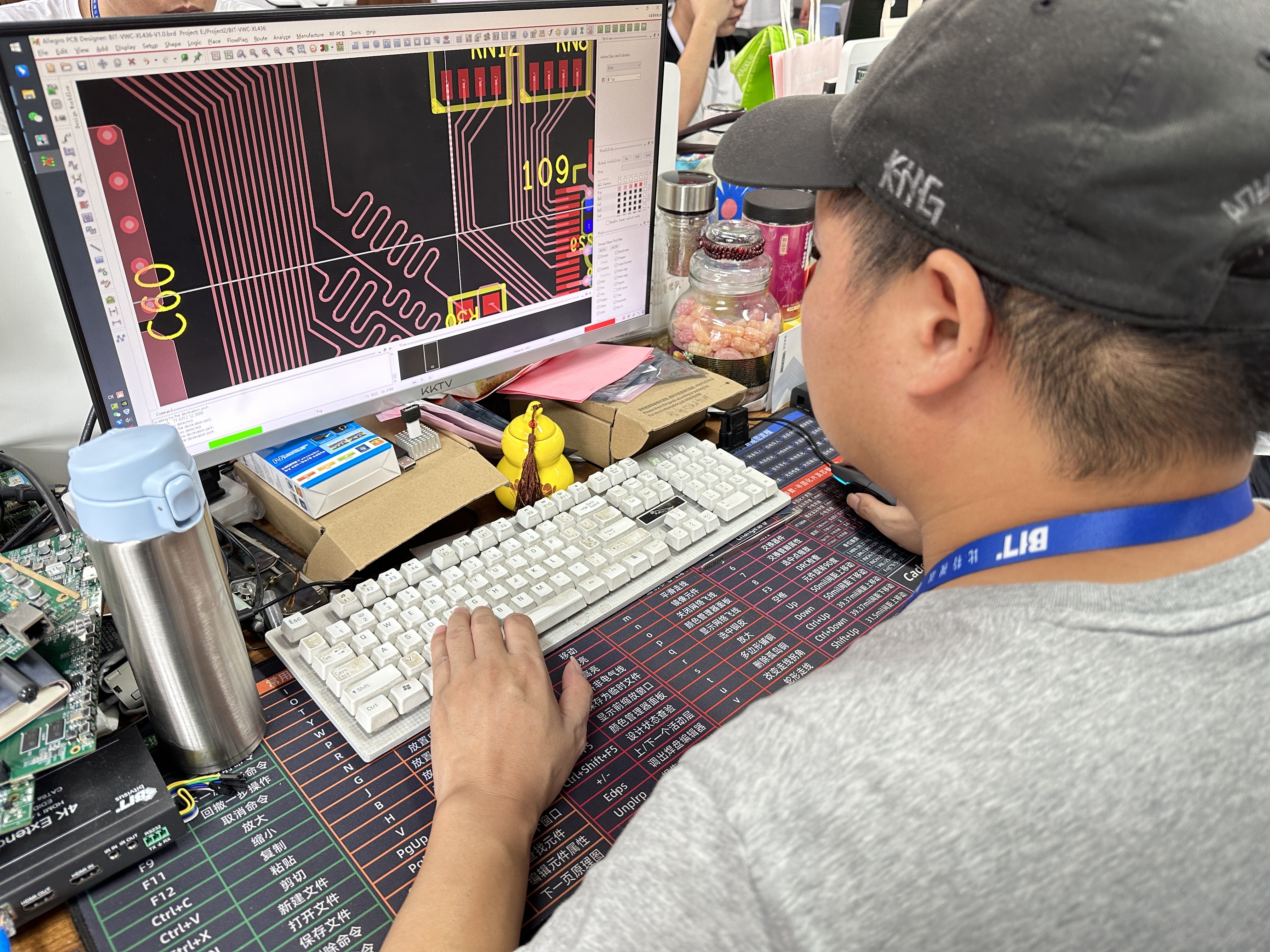
Testing lab at Bitvisus: each controller completes a 48-hour aging test before delivery, one of the process controls behind the reliability figures cited in both deployments.
Next step: review your controller configuration before you specify
Send your projector count, target resolution per cluster, and the distance between the control position and the projectors, and the team will map your project onto the Rank 1 or Rank 2 pattern and confirm the controller, expander and extender combination that fits.
Contact: Eddie · Email: eddie.jia@bitvisus.com · Tel / WhatsApp: +86 186-8150-9089 · Address: Building 2, 6th Floor, West Side, Zhongyuntai Technology Industrial Park, South of Tangtou 1st Road, Shiyan Sub-district, Bao'an District, Shenzhen, Guangdong Province, 518108, China
Download: 2026 Bitvisus Product Brochure (PDF) — full product range, specifications and configuration guidance.
Have Questions or Need More Details?
Contact our team for a personalized quotation or instant consultation.
Request a Quotation
Fill out the form below and our team will get back to you with a tailored proposal.
WhatsApp Direct Chat
Prefer to chat in real-time? Message us on WhatsApp for instant assistance & quick answers.
- Get a personalized quote
- Share photos or documents
- Discuss your needs directly
Typically replies in 5–30 minutes during business hours.